
Briggs & Stratton Q6500 Review & Buyers Guide
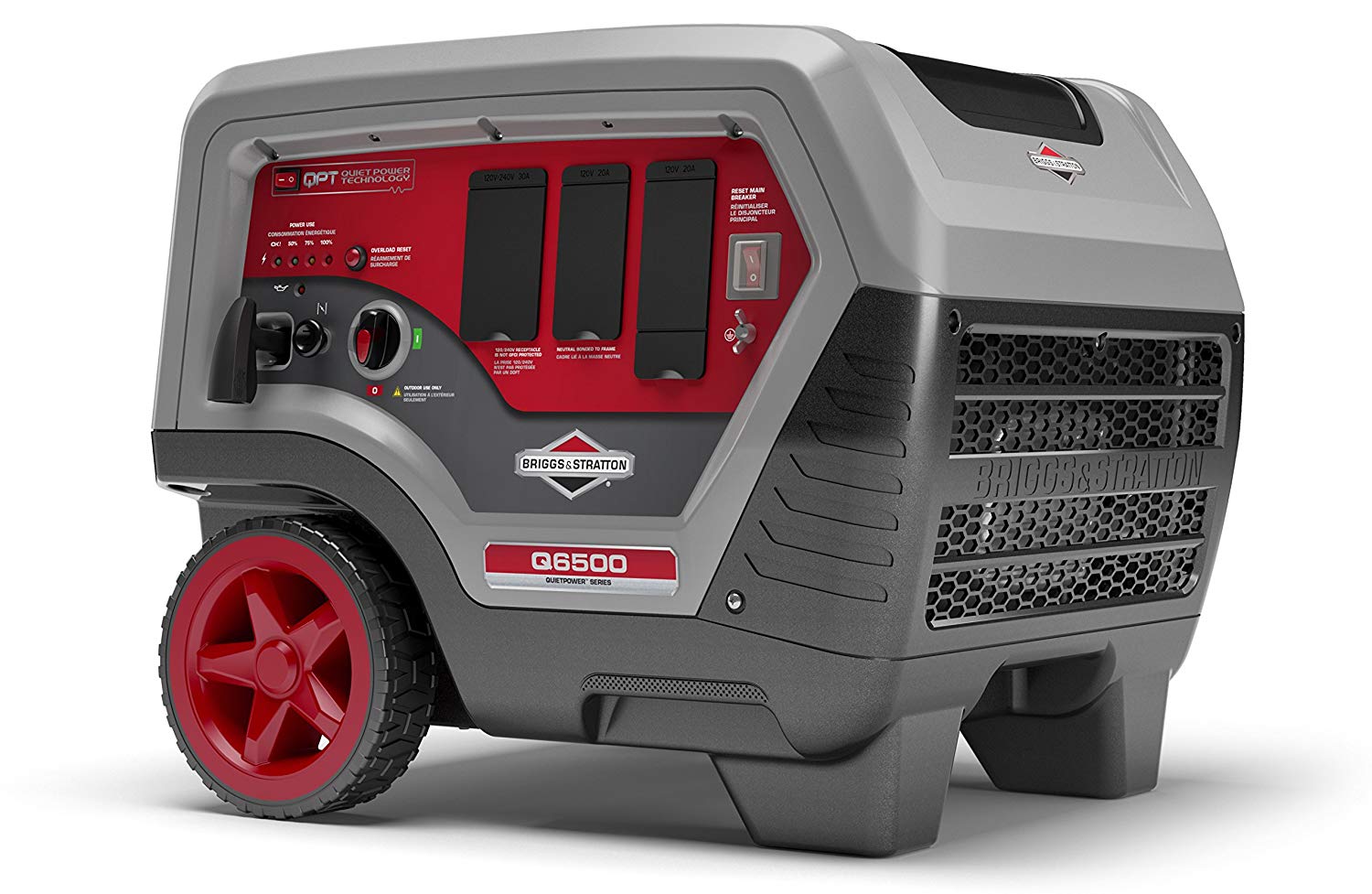
This review is not based on any personal tests done on the product but rather a comprehensive overview of the Q6500 derived from expert reviews, customer comments and the specifications provided by the manufacturer. Any conclusions drawn in this review are based on a comparison of these three different sources of information. [wp-review] Inverter generators have many advantages such as quiet running, being highly portable and having a low THD percentage. However, there is one downside to most models – most inverters have a low capacity which for many is the main reason to switch to a conventional portable generator. Fortunately, a few of the best generator brands are releasing higher power inverter generators with the Briggs & Stratton Q6500 being an excellent example. With 6500 starting watts and 5000 running watts it is comparable to a mid-size portable generator but without the noise, better energy efficiency and cleaner electricity. Are medium capacity inverter generators going to beat out regular gasoline generators of the same size? Does it truly have all the advantages of a same-size conventional portable generator without any of the disadvantages? Read on for more user information on the Briggs & Stratton Q6500 inverter generator and decide whether it is time for switching to this more advanced generator technology?About the Q6500
[su_box title=”Q6500 Instructional Video” style=”2″] [su_youtube url=”https://www.youtube.com/watch?v=mWOd2RvouIA”] [/su_box] [su_box title=”Q6500: Technical Specs” style=”2″]| Product Information | Detail |
|---|---|
| Running Watts | 5,000 watts |
| Surge Watts | 6,500 watts |
| Tank Size | 5 Gal |
| Runtime | 14 hrs @ 1/4 load |
| Fuel | Gasoline |
| Noise level | 66 dB |
| Weight | 138 lbs |

When you buy through our links, we may earn a commission.
Price and availability are accurate as of 06/19/2026 03:32 pm GMT and are subject to change.
Price and availability are accurate as of 06/19/2026 03:32 pm GMT and are subject to change.
Q6500 vs 7000-watt Elite Series vs P4500 PowerSmart Series
Table could not be displayed. Briggs & Stratton has 3 signature generator series including the Elite Series and the PowerSmart Series. Let’s make a quick comparison between the Q6500 and a similar sized model from the other two series. If you are willing to forego the low THD and better portability for more power, the 7000-watt Elite Series generator is good alternative. This reliable model is meant for commercial purposes and has many interesting features. The signature PowerSurge feature makes this unit even more powerful than its 7000 running watts and 8750 peak watts. This engine is capable of delivering a short but very powerful current to kickstart heavier electronic appliances without smaller capacity appliances losing power. On the other hand, if fuel efficiency is your priority, look into the PowerSmart Series. The P4500 which has less power but is arguably also more portable is recommended as an RV generator. The P4500 lasts for 16 hours on a 25% load with a full 3.5 gallon fuel tank. This is clearly more efficient than the Q6500 but it also beats the 9 hours on a 50% load of the 7000-watt model. Overall, the P4500 gets closer to the standard inverter generator features. It runs more quietly, it is parallel capable and it is more lightweight than the Q6500. Being parallel capable is its biggest selling point so if you are looking for all the benefits of an inverter generator but with more power, the P4500 is an excellent choice. If the inverter generator advantages are less of a concern and the focus is on reliability and heavy duty use, the Elite Series is where you should look.Briggs & Stratton Q6500 vs Westinghouse iGen4500 vs Honda EU7000is
Table could not be displayed. There are few inverter generators with as much power as the Q6500 so we draw a comparison with the Westinghouse iGen4500. It has 4500 peak watts and 3700 running watts. A stronger competitor is the Honda EU7000is with 7000 watts surge power and 5500 watts continuous power. It is still more powerful than the Briggs & Stratton model but for continuous power it is quite similar. Overall, all 3 models are very compact for the amount of power that they deliver. In terms of portability the Westinghouse wins because it is the lightest and has both carrying handles and a pulling handle. Fuel efficiency is won by the Honda with a run time of 18 hours on its 5 gallon fuel tank. The Westinghouse inverter also reaches 18 hours of run time but that is on a much smaller load. One undeniable fact is that the Honda EU7000is is expensive. Even though it only gets rave reviews from experts and is one of the most reliable generator brands out there, its price point puts it outside of the budget for many consumers. So, considering the price, the Briggs & Stratton Q6500 is still the best option. You get more power than with the Westinghouse with many of the same inverter generator advantages. Alternatively, you could make use of the parallel capabilities of the Westinghouse generator but this again places you at a much higher price point. In terms of value, the Briggs & Stratton Q6500 delivers more.Advantages and Disadvantages
[su_box title=”Advantages” style=”2″] Its greatest advantage is that it delivers the power of a mid-size conventional portable generator but weighs much less and has a much better portable design. In other words, it is the more convenient choice for a generator of that capacity. The rear wheels and telescopic handle means it is easily tugged along, even on rough terrain. This makes its heaviness a lesser disadvantage. The dimensions are quite small considering its output so it much easier to store than a conventional portable generator. The number of different types of outlets is a welcome feature. It makes the entire unit more versatile, whether you use it as an emergency home backup generator, for an RV or tailgating. It is a great choice for powering the more sensitive household electronics like the TV or computer. Conventional gas-powered portable generators have an unsteady current which damages electronics but the Q6500 has a low THD and so is a perfectly safe electricity source for them. Finally, it is a very fuel efficient engine. The fuel tank is relatively large which gives you plenty of run time. [/su_box] [su_box title=”Disadvantages” style=”2″] Inverter generators are meant to be quiet and at 66 decibels this machine is far louder than smaller capacity inverters. It is important to note that more power naturally means more noise but it remains a downside of the Q6500. Considering the many noise cancelling elements such as the steel frame and Quiet Power Technology, you would expect a quieter engine. It will be interesting to see if future models of the same capacity will manage to stay below the 62 decibels mark. We have come to expect parallel capabilities from inverter generators so it is disappointing that the Q6500 is not. One could argue that it is overkill for the amount of power it already puts out but it would still be a great feature. Those that want to use this generator for their RVs might be disappointed in the drop of power. When combined with an RV adapter, this unit only reaches a maximum of 4800 watts. [/su_box]Conclusion
The beauty of the Briggs & Stratton Q6500 is that you get more than twice the power of the most common inverter generators but in one compact package. It is the perfect marriage of a hand-carry inverter generator and powerful conventional portable generators. However, there are a few disappointing features, especially considering the improved elements in the Briggs & Stratton P4500. A few more improvements would make the Q6500 unbeatable. To conclude, there are better alternatives for large inverter generators however compared to a conventional portable generator, the Q6500 is the clear winner.
When you buy through our links, we may earn a commission.
Price and availability are accurate as of 06/19/2026 03:32 pm GMT and are subject to change.
Price and availability are accurate as of 06/19/2026 03:32 pm GMT and are subject to change.
Last update on 2026-06-20 / Affiliate links / Images from Amazon Product Advertising API