
If you camp off-grid even a few weekends a year, a portable solar kit can save your batteries and your ears. It keeps lights, fans, water pump, and a 12 volt fridge running without babysitting a generator. It is also the quiet partner to an inverter generator on longer trips. Let the panels refill your battery bank during the day so you burn less fuel and avoid hauling extra propane or gas.
This guide is for RVers, van owners, trailer campers, and anyone boondocking who wants a simple, portable way to charge 12 volt batteries or a portable power station. We focus on complete kits that are easy to deploy at camp. That includes folding suitcase panels with charge controllers, roof friendly starter kits, and integrated battery plus inverter power stations with matching panels.
What matters most is matching the kit to what you actually run. Solar is steady but slow. Expect it to handle your daily recharge, not to power a rooftop air conditioner. Shade hurts output more than people expect, and short winter days cut harvest in half. The right controller, wire size, and connectors make as much difference as the panel wattage on the box.
Our picks and advice come from real use. We look at charging performance in mixed sun, controller quality and battery compatibility, portability and weight, build and weather protection, connector choices, and how easy it is to expand later. We also flag the downsides. Cheap PWM controllers leave watts on the table. Thin cables drop voltage. Lithium batteries do not like to charge below freezing without a heater.
Quick Comparison
Do this first: write down a one day power budget. Add up your essentials in watt hours. Example: 12 volt compressor fridge 40 watts average for 24 hours is about 960 watt hours. Two LED lights at 5 watts each for 4 hours is 40 watt hours. Laptop at 60 watts for 2 hours is 120 watt hours. Aim for solar that can reliably make that much energy per day in your season, with a buffer. As a back of napkin, 200 watts of portable panels will net roughly 600 to 800 watt hours on a good summer day if you manage shade and tilt.
How to choose the right camper and RV solar kit
Start with your loads and a simple sizing rule
- Tally daily watt hours. Essentials: fridge, lights, fans, phone, water pump, detector standby. Optional: laptop, camera, router, CPAP.
- Convert battery capacity to usable energy. A 100 amp hour 12 volt AGM gives about 600 watt hours you can use comfortably. A 100 amp hour 12 volt lithium is closer to 1,200 watt hours.
- Rule of thumb: target panel watts equal to 0.75 to 1.25 times your daily watt hours divided by 4 to 5 peak sun hours. For a 1,000 watt hour day, start around 200 to 300 watts of panels in summer, more for shoulder seasons.
Pick a kit style that matches how you camp
- Portable suitcase panel with built in controller: best for simple battery charging at camp. Set it on the ground, point at the sun, clip to your battery.
- Portable power station plus folding panels: best all-in-one. Battery, inverter, and charge controller in one box with AC and DC ports. Great for renters or multi use between home and rig.
- Roof or van starter kit: best if you park in sun often and want charge while driving. Cleaner wiring, always charging, less setup. You still may carry a small portable panel to chase sun in tree cover.
Controller type and battery compatibility
- MPPT vs PWM. MPPT harvests more energy in cold or partial shade and with higher voltage panels. PWM is cheaper but wastes headroom. If you rely on solar daily, pick MPPT.
- Battery chemistry. Make sure the controller supports your battery type and charge profile. AGM and flooded need different voltages than lithium. Lithium should have low temperature protection if you camp below freezing.
- System voltage. Most small rigs are 12 volt. Some larger setups are 24 volt. Match panels, controller, and battery to the same plan.
Portability, build, and connectors
- Weight and size. A 200 watt suitcase can be 30 to 40 pounds. If you move camp often, a lighter 100 to 160 watt foldable may get used more.
- Hardware. Look for solid kickstands, tight hinges, edge protection, and a decent carry case. IP65 or better helps in light rain.
- Connectors. MC4 is the RV standard. Anderson SB50 and 8 mm show up on power stations. SAE is common on trailer prewires. Adapters are fine if they lock firmly and are rated for the current.
Expandability, wire, and protection
- Plan for growth. Can you parallel a second panel later. Does the controller have headroom for more amps.
- Cable length and gauge. Keep panel to controller runs short, size wire for low voltage drop. Longer runs may need 10 AWG or 8 AWG.
- Fusing. Fuse within 7 inches of the battery positive. Use a breaker or fuse between controller and battery sized to the wire and controller rating.
Quick setup and install overview
Portable setup in minutes
- Park with the biggest window of unshaded sun you can get.
- Set the panel facing south in North America with a slight tilt. Re-aim at lunch if you can.
- Connect controller to battery first, then panels to controller. If you use a power station, follow its solar input guide.
- Use an inline fuse near the battery. Keep cables off hot surfaces and away from foot traffic. Close battery vents and lids after connecting.
Roof or van basics without the headaches
- Measure roof space and map around vents and A/C. Leave a path for maintenance.
- Mount with proper brackets and sealant on clean surfaces. Use a weatherproof gland for wire pass-through.
- Keep the controller close to the battery to cut voltage drop. Size wires for the controller’s max current plus margin.
- Add a disconnect breaker between panels and controller, and between controller and battery. Label everything. Strain relief your MC4 connections.
Common pitfalls to avoid
- Shading even a small corner of a panel can slash output. Move the panel or split arrays to chase sun.
- Undersized wire kills watts. If cables feel warm, they are too small.
- Mismatched panels in series or parallel can drag the array to the lowest performer. Keep panel models and orientations the same when possible.
- Lithium charging below freezing can harm cells. Use a controller or battery with low temp cutoff or a heated battery.
- Do not leave a controller powered by panels with no battery connected. Most need a battery reference first.
Start simple. Power what matters. Add panels or battery later if you come up short. The goal is quiet, reliable energy without overspending or overcomplicating your setup.
1. ECO-WORTHY 800W RV Off-Grid Solar Kit with 7.2kWh Lithium and 3000W Inverter
Best high-capacity kit

Go off-grid with ease: 800W bifacial panels, 3000W inverter/UPS, dual solar/shore charging, and big lithium storage. Quick 4-step setup—see if it fits your rig.
$2,299.99 on Amazon
Price and availability are accurate as of 03/19/2026 08:13 am GMT and are subject to change.
Who this is for: RVers and van folks who want real off-grid independence without juggling separate boxes. If you run a 12V fridge, lights, fans, chargers, and you want the headroom for a coffee maker or microwave now and then, this kit makes sense. If you only need to top off a single battery on weekends, look at a small suitcase panel instead.
Why we picked it: The combination of 800W bifacial solar, 7.2kWh of lithium storage, and a 3000W inverter/UPS covers the majority of camper use cases in one package. Solar harvest is strong enough to recover daily loads in fair weather. The storage is big enough to ride through a cloudy day. And dual solar/shore charging means you can refill from hookups when the sun does not cooperate. It is a clean way to go from zero to a capable off-grid system without piecing parts together. You can check specs and availability here: ECO-WORTHY 800W RV Off-Grid Solar Kit with 7.2kWh Lithium and 3000W Inverter.
Trade-offs: This is not a compact suitcase you toss in a trunk. It needs roof or rack space for the panels and a safe spot inside for the battery and inverter. The price is higher than panel-only kits. Install takes planning. Shade still hurts, even with bifacial panels.
Practical tip: Before you buy, measure panel footprint and map your cable paths. Keep the battery and inverter close to each other, mount panels where they see the most sun, and use shore charging as your backup plan on cloudy stretches. Start with essentials first, then add heavier AC loads once you see your real-world harvest and usage.
2. DOKIO 100W Foldable Solar Panel Kit with Controller & USB for 12V Batteries and Power Stations
Best compact/foldable

Travel-friendly 100W solar panel: just 6lb, folds small, long 3m lead, PWM safety, and handy USB ports—ideal for vans, tents, or backup. Check your power station’s input cap.
$68.77 on Amazon
Price and availability are accurate as of 03/19/2026 03:52 am GMT and are subject to change.
Who it’s for: weekend campers, van folks tight on space, and anyone who wants a simple way to top off a 12V battery or a small power station. If you’re running lights, phones, a fan, and maybe a small cooler, this 100W foldable is a low-hassle option that fits behind a seat.
Why we picked it: it’s very light, folds down small, and the 3 m lead makes placement easy. The included basic PWM controller and USB ports mean you can charge a 12V battery safely and still top up a phone without extra gear. In clear summer sun, a 100W panel like this can net a few hundred watt-hours per day, which is enough to offset typical DC loads in a camper.
Trade-offs: the PWM controller leaves some charging efficiency on the table compared to MPPT, and 100W will feel tight if you’re trying to keep a compressor fridge running in hot weather or you hit a string of cloudy days. Like most foldables, treat it with care and store it dry to protect the fabric and cells.
Practical tip: park the rig in the shade, run the 3 m lead out to full sun, and tilt the panel toward midday sun for better harvest. If you plan to feed a power station, check its input watt limit and connector type before you buy. See current specs and compatibility notes on the DOKIO 100W Foldable Solar Panel Kit with Controller & USB for 12V Batteries and Power Stations.
3. OUPES Guardian 6000 Solar Generator Kit, 4608Wh, 6000W (7200W boost), 120/240V dual-voltage, 2x240W solar panels
Best integrated kit with battery
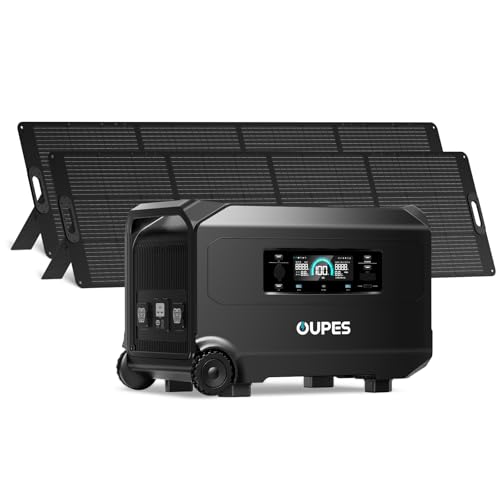
Turn outages into smooth sailing: portable 120/240V whole-home backup with UPS, app control, and room to expand. Includes panels—plug into transfer switch and go.
$2,799.00 on Amazon
Price and availability are accurate as of 03/19/2026 06:18 am GMT and are subject to change.
Who this is for: RVers or homeowners who want a single kit that can cover real appliances, not just phones and lights. If you plan to feed a transfer switch at home or power a larger trailer with big loads, the OUPES Guardian 6000 makes life simple. It is a portable 120/240V unit with a 6000W inverter, a 4608Wh battery, UPS, app control, and two 240W panels in the box.
Why we picked it: Dual-voltage output is rare in a portable kit. That means you can run mixed loads cleanly and tie into a transfer switch without hacking adapters. The 6000W inverter handles the surge of heavier gear. Think short runs of a small air conditioner, a microwave, or a well pump, plus the usual fridge, lights, fans, and CPAP. With 4608Wh on tap, you get a lot of runway. A small 12V fridge that averages about 40W can run for roughly 3 to 4 days. A 1000W coffee maker for 10 minutes uses about 0.17kWh, which is a small dent in this pack. You can check current specs and availability on OUPES Guardian 6000 Solar Generator Kit, 4608Wh, 6000W (7200W boost), 120/240V dual-voltage, 2x240W solar panels.
Trade-offs: This is not a grab-and-go suitcase. It is large, and the 480W of included solar will refill the battery more slowly than some expect. Figure roughly 2.0 to 2.5kWh on a sunny day from those panels, which means a full refill takes a couple of good days if you are drawing it down hard. The price only makes sense if you will use the 120/240V capability and bigger inverter.
Practical tip: If you plan to backfeed a home subpanel, install a proper transfer switch and inlet. Label circuits and stagger high-draw loads like microwaves and space heaters. Park the panels in clear sun, tilt them when you can, and keep them clean. If you boondock often, budget for more solar so you can keep up with daily use rather than playing catch-up.
4. Renogy 200W N-Type 12V Solar Starter Kit with 2x100W Panels and 30A PWM Controller
Best 200W starter kit

Plug into off-grid power: this 200W kit installs fast, makes ~1000Wh/day, and scales to 400W. Smart controller protects most batteries—see if it fits.
$220.99 on Amazon
Price and availability are accurate as of 03/19/2026 12:41 am GMT and are subject to change.
Who this is for: RVers and van folks who want a straightforward, reliable 12V charging setup for lights, fans, water pump, device charging, and a small 12V fridge. If you run a 100 to 200 Ah 12V battery and camp a few days at a time, this 200W kit is a clean starting point that does not overcomplicate the install.
Why we picked it: It hits the sweet spot for entry-level roof or rack installs. Two 100W panels with a 30A PWM controller are easy to live with and easy to wire. In decent sun you can make about 1000 Wh per day, which keeps a typical camper battery topped up while you enjoy quiet campsites. When your needs grow, you can expand to 400W without tossing the whole system. For specs and battery compatibility, see Renogy 200W N-Type 12V Solar Starter Kit with 2x100W Panels and 30A PWM Controller.
The trade-offs: A PWM controller is less efficient than MPPT, especially in cold or variable conditions. You also need a battery and, if you want household outlets, an inverter. Fixed panels mean you are chasing sun angles instead of just moving a suitcase panel into a sunny patch. Shade will cut production fast.
A practical tip: Keep the controller close to the battery, set the correct battery type before charging, and use proper fusing on the battery positive. If you add more panels later, stay mindful of controller limits and wire gauge to avoid voltage drop. Tilting the panels when parked can add meaningful watt-hours on shoulder-season trips.
FAQ
Setup
- How many watts do I need for a weekend of boondocking?
For a typical setup with a 12V compressor fridge, LED lights, phone charging, and a vent fan, plan on roughly 600 to 800 Wh per day. That maps to:
- Panels: 200 W is the bare minimum in good sun, 300 to 400 W is the safer target.
- Battery: 100 Ah LiFePO4 (about 1,200 Wh) gives a solid 1 to 2 days of buffer without sun.
If you add a laptop, camera batteries, or a small DC water pump, lean toward 300 to 400 W of solar.
- Do I really need an MPPT charge controller?
For small 100 to 200 W suitcases, PWM is fine and cheaper. MPPT is worth it if you run 300 W or more, have longer cable runs, want to wire panels in series for higher voltage, or camp in cold or cloudy conditions. Expect roughly 10 to 25 percent better harvest with MPPT in real use.
Troubleshooting
- My panels show power, but the battery isn’t charging much. What’s wrong?
Check the simple stuff first:
- Shade kills output. Even a roof vent shadow can tank watts.
- Tilt and aim at the sun. Flat panels often give 20 to 40 percent less.
- Clean the glass. Dust and pollen matter.
- Controller settings: correct battery type and charge voltages.
- Cables: too thin or too long means voltage drop. Use proper gauge and short runs.
- Connections: MC4s fully clicked, polarity correct, fuses intact.
- Battery state: charge slows as it nears full, and some lithium BMSs block charging when cold.
Buying decisions
- Power station kit or panel plus 12V battery system?
- Power station: Easiest. All-in-one with inverter, fast charging, app control. Great for mixed AC and DC use and quick setups.
- 12V battery system: Better dollars per watt-hour, easier to service and expand, ideal for permanent van or RV builds.
If you want true plug and play and move it between home and rig, get a power station. If you plan to grow into roof panels, DC loads, and custom wiring, build around a 12V battery and separate components.
If your goal is quiet power without babysitting a gas generator, a portable solar kit is the easiest way to get there. Start with what you actually run. Lights, phones, fan, and a 12V fridge are easy. Microwaves and rooftop AC are not.
Small suitcase panels are the best value if you already have a good RV battery. Power stations with folding panels make sense if you want one-box simplicity and clean AC power. Roof kits shine for longer trips when you can leave panels up and let them work all day.
Buy once, right-size it, and keep your wiring simple. Shade kills solar, thin wire wastes it, and unrealistic expectations make people hate it. Focus on essentials and you will be happy.
Your next steps
Quick decision recap
- Weekend tailgater or boondocker with a healthy 12V battery: a 100 to 200 watt suitcase with a basic controller is enough for lights, phones, router, and a 12V fridge.
- Week-long trips, laptop work, camera gear, CPAP: a 1 to 2 kWh power station with 200 to 400 watts of panels covers daily charging and quiet nights.
- Full-time van or small RV, fixed install: a 400 watt roof kit with an MPPT controller is a strong baseline. Add portable panels if you camp in shade.
- Heavy AC loads like microwave use or a small coffee maker: pair a 1.5 to 2 kWh power station with at least 400 watts of panels, or run an inverter generator for short bursts.
- Big RV with TT-30 needs: consider a larger power station that supports RV outlets and at least 400 watts of solar, and keep a fuel generator as backup.
10-minute sizing checklist
- List daily watts: phone 10 to 20 Wh, laptop 50 to 100 Wh, 12V fridge 300 to 600 Wh, router 50 Wh, lights 20 to 50 Wh, CPAP 100 to 300 Wh.
- Tally a day: most modest campers land near 400 to 800 Wh per day. Creators or winter campers can hit 1 to 2 kWh.
- Panel rule of thumb: daily Wh divided by 3 to 4 equals a realistic panel watt target in sunny months. Example: 800 Wh needs about 200 to 300 watts of panels.
- Battery rule of thumb: daily Wh times 1.5 to 2 equals a good battery size so you are not empty each morning. Example: 800 Wh per day needs 1.2 to 1.6 kWh.
- Controller check: prefer MPPT when panel watts exceed 200 or when temps swing. PWM is fine for small suitcases.
- Wiring sanity: use MC4 where possible, 10 AWG for portable runs, fuse at the battery, and keep cable runs short.
Edge cases to plan for
- Cold and cloudy trips: cut expected solar harvest in half. Double your panels or bring a backup generator.
- Absorption fridges on propane still draw 12V power. Plan for 50 to 100 Wh per day just for the board and fans.
- Roof AC is a different animal. Even 800 watts of panels struggle to keep up. Run AC on shore power or a generator.
- Lead-acid batteries need full absorption charging. If you only drive short hops, add solar to finish the charge or upgrade to lithium.
How we test and how to support this work
What we verify in the field
- Real charging rates: we measure watts at the controller or power station in morning, mid-day, and late sun, with and without tilt.
- Shade and heat behavior: panels and controllers lose output when hot. We note drop-offs and look for honest wattage.
- Connectors and setup time: if a kit takes 15 minutes to deploy or needs adapters, we say so.
- Noise and usability: latches, hinges, handles, and screens matter when you set up daily. We favor gear you will not dread using.
- Compatibility: we check MC4, 8 mm, and XT60 style leads, plus 12V battery profiles for AGM and lithium.
Our affiliate disclosure
We fund this site with affiliate links. If you buy through our links, we may earn a small commission at no extra cost to you. We do not accept money to pick winners, and we do not let brands preview our verdicts. If a product is loud, flimsy, or overhyped, we say so.
Keep going
- Ready to pick a power station and panels together: see our Solar Generators guide for tested setups that pair well with RVs.
- Want a fuel backup for bad weather stretches: our RV Generators guide covers quiet inverter options that sip fuel.
- Curious about specific panels and bundles: check our hands-on EcoFlow and Goal Zero reviews for charging performance and connector details.
If you are still on the fence, start small. A 100 to 200 watt suitcase will teach you more in one weekend than hours of spec sheet reading. Watch your daily watt-hours, tweak your habits, then size up with confidence. The north star is simple: power what you need, reliably, without overspending.