
If you’ve lived through a storm outage, tried to run a CPAP in a campground without hookups, or needed quiet power for an RV or job site, a portable solar power system can make life a lot easier. These are battery-based “solar generators” that you can charge from the wall, your vehicle, or folding solar panels, then run phones, lights, routers, fridges, tools, and more without gas, fumes, or noise.
I’m a former electrical contractor who’s owned just about every type of generator you can think of. What most people want is simple: a safe, reliable box that keeps essentials running and tops itself up from the sun. In this guide we cut through spec sheets and focus on what actually matters in the field.
Use this roundup to match a unit to your reality. We group picks by scenario, explain specs in plain English, and give conservative real-world runtimes. The big decision points are battery capacity in watt-hours, inverter output in watts (continuous and surge), solar input and recharge speed, weight and portability, durability, ports you’ll actually use, and warranty support.
Do this first: make a short list of what you need to power and for how many hours. Add up the running watts, note any appliances with a starting surge, and add a 20 to 30 percent buffer. That simple exercise prevents most buying mistakes.
Quick Comparison
A quick reality check: portable solar systems are great for electronics, fridges, medical devices, routers, lights, and small tools. They are not a good match for central air, electric water heaters, or long runs on space heaters. Also remember that most power stations are not weatherproof. Keep them dry and shaded and they will treat you well.
What a portable solar power system is and where it fits
The basics in one minute
A portable solar power system is usually two pieces: a power station and solar panels. The power station is a lithium battery with a built-in inverter that makes household AC power, a solar charge controller to accept panel input, and DC outputs like USB and 12V. Panels plug in through MC4 or brand adapters and feed the battery when the sun is up. You can also recharge from a wall outlet or your vehicle.
Where these shine
- Short to medium home outages to keep a fridge cycling, phones and laptops charged, the router online, and a few lights on.
- RVs and vans for running a compressor fridge, fans, device charging, induction cooktop in short bursts, and a coffee maker.
- Camping and tailgating where quiet power matters and generators aren’t allowed.
- Light job site work like charging tool batteries and running a miter saw in short cuts.
Where they fall short
- High draw appliances for long periods like space heaters, electric dryers, and central air.
- Deep well pumps or large shop tools unless you size into the big, heavy units.
- Continuous outdoor use in rain or snow. Most units are not weather rated and need shelter.
How to choose the right unit (read this first)
Capacity and inverter output, translated
- Battery capacity (Wh) tells you how much energy is stored. Rough runtime rule: hours ≈ battery Wh × 0.85 divided by your average load in watts. The 0.85 accounts for inverter losses.
- Inverter power has two numbers: continuous watts for steady loads and surge watts for short start-up spikes. Make sure continuous covers your running load and surge covers the highest startup device.
Solar input and recharge speed
- Look for a real MPPT solar controller and the maximum solar input in watts. More input means faster refills on sunny days.
- As a rough guide, a 400 W panel array will put about 250 to 320 W into the battery under good sun after losses. A 1,000 Wh station might go from empty to near full in 3 to 4 hours of strong midday sun, longer in shoulder seasons.
Battery chemistry and cycle life
- LFP (LiFePO4) batteries typically last more cycles and handle daily use better, with a tradeoff of extra weight.
- NMC batteries are lighter for the same capacity but usually have fewer cycles. Both need protection from extreme cold when charging.
Portability and durability
- Weight and handles matter once you pass 1,000 Wh. Wheels help for larger units.
- Check build quality, connector strain relief, fan noise, and whether the 12V output is regulated. Most power stations are not waterproof. Plan on a dry, shaded spot and a panel stand or kickstands.
Outputs and expandability
- Must-haves for most people: at least two grounded AC outlets, 60 to 100 W USB-C PD for laptops, and a stable 12V output for fridges or CPAP.
- RV users may want a 30A RV outlet. Some larger units allow extra batteries or even 240V split-phase with two units and a hub.
Warranty and support
- Look for at least a 2 to 5 year warranty depending on size, and a brand with accessible support and spare parts. Clear manuals and firmware updates are a plus.
1. OUKITEL P5000 Pro 5120Wh Solar Generator + 400W Panel, 3600W AC (6000W Surge) for Home Backup & Camping
Best for RVs and vans

5.1kWh power you can roll anywhere—2.8h recharge, 15 ports, UPS-ready, LiFePO4 for years of use. Solar-ready and great for outages or RVs—worth a closer look.
Price and availability are accurate as of 10/14/2026 02:35 am GMT and are subject to change.
Best for RVers, vanlifers, and anyone who wants a serious mobile battery they can roll into place, the OUKITEL P5000 Pro brings real home-style power on the road. With 5.1kWh on tap and a 3600W inverter (6000W surge), it can run the usual essentials together and still have headroom for short bursts from things like a microwave or power tools. It also makes a strong home-backup hub thanks to UPS capability that keeps critical devices on during blips.
We picked it for the combo of big capacity, high inverter output, fast AC recharge around 2.8 hours, and a long-life LiFePO4 battery. In practice, that means you can keep a full-size fridge cycling, run lights and Wi‑Fi, charge devices, and still have room for a coffee maker or induction plate one at a time. The 15 ports make it easy to spread power to laptops, CPAPs, and 12V gear without a tangle of adapters. If you want the full spec rundown, see OUKITEL P5000 Pro 5120Wh Solar Generator + 400W Panel, 3600W AC (6000W Surge) for Home Backup & Camping.
Trade-offs are the obvious ones. A 5kWh box is not a featherweight, so plan to roll it rather than carry it. And while the included 400W panel is a good start, recharging this much battery on solar alone takes time. If you rely on sun for day-to-day power, consider adding more panels if the unit supports it, or top up on AC whenever you can.
Practical tip: treat it like a portable “critical loads” panel. Group your must-haves on a small power strip, avoid running multiple heat-making appliances at once, and keep the unit shaded while panels sit in full sun. That simple discipline stretches your runtime and keeps you ready for the next outage or travel day.
2. EcoFlow DELTA 3 Portable Power Station – 1024Wh LiFePO4, 56‑min full recharge, 1800W AC, 100W USB‑C, solar‑ready
Best Fastest recharge pick

Full recharge in 56 min. Power 13 devices, handle 2600W+ with X-Boost. Expand to 5kWh on LFP cells built for 10 years. See if it fits your setup.
$599.00 on Amazon
Price and availability are accurate as of 10/14/2026 05:58 pm GMT and are subject to change.
Who this is for: If you want a midsize power station that can bounce back fast after an outage or between job site runs, the DELTA 3 hits a sweet spot. It is compact enough for apartments, RVs, and cabins, but strong enough to cover core needs like a fridge, lights, internet, and device charging. The 100W USB‑C makes it a clean fit for remote work setups too.
Why we picked it: The 56‑minute wall recharge is the draw. You can top off in under an hour during a grid window, then ride through the next blackout. The 1800W inverter covers most kitchen countertop appliances and space heaters within reason, and X‑Boost helps with short startup surges. With 1024Wh on tap, expect something like 8 to 12 hours on a modern refrigerator cycling, or a full day running a Wi‑Fi router and laptop plus phone charging. Check full specs and compatibility on EcoFlow DELTA 3 Portable Power Station – 1024Wh LiFePO4, 56‑min full recharge, 1800W AC, 100W USB‑C, solar‑ready.
Trade-offs: This is still a midsize box, not a featherweight. It is not meant for whole‑home coverage, and if you plan to expand, you are buying brand‑specific batteries to reach that ~5kWh mark. Also remember the headline-fast 56‑minute refill is via wall power; solar refills depend on panel wattage and sun, so plan half‑day to full‑day windows if you are relying on portable panels.
Practical tip: Pair it with 200 to 400 watts of folding solar if you want meaningful daytime recovery. Use the 100W USB‑C for laptops and the DC ports for small gear to avoid inverter overhead. In an outage, cycle heavy loads: run the fridge a couple hours, then let it coast with the door closed. That stretches this unit’s 1024Wh much further.
3. EF ECOFLOW DELTA Pro 3600Wh Portable Power Station, 3600W, 2.7h fast recharge, LiFePO4
Best for Home Backup
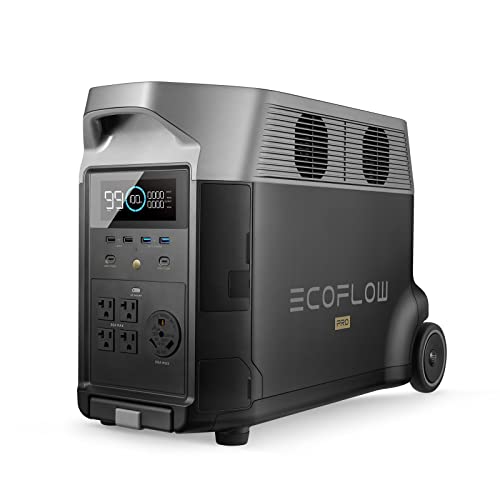
Big home backup you can take anywhere: 3.6kWh (expandable), 3600-7200W output, super-fast charging, app control, even EV top-ups. Potential 30% credit – check eligibility.
$1,899.00 on Amazon
Price and availability are accurate as of 10/13/2026 11:01 pm GMT and are subject to change.
If you want a serious, quiet home backup you can actually move around, this is the one I reach for. The 3.6 kWh battery and 3600 to 7200 watts of output let you run a fridge, lights, Wi-Fi, charge devices, and still have headroom for short bursts on a microwave or power tool. It also has app control so you can see what is drawing power and stretch your runtime without guesswork. For full details and testing notes, see our hands-on take here: EF ECOFLOW DELTA Pro 3600Wh Portable Power Station, 3600W, 2.7h fast recharge, LiFePO4.
Why I picked it for home backup: capacity plus fast charging. Being able to refill in roughly 2.7 hours from a wall outlet means you can top it off between rolling outages or before a storm hits. As a simple rule of thumb, battery hours ≈ 3600 Wh divided by your average load. So at 300 watts average, you’re looking at around 10 to 12 hours per charge, longer if you add daytime solar or stagger big loads.
Trade-offs are size and cost. It’s heavy for one person to lift, and if you try to run resistive heat or big AC continuously, you’ll burn through the battery fast. Plan to pair it with enough solar to make a dent during daylight, or add extra capacity if you want multi-day independence. There may be a federal clean energy credit available up to 30 percent for eligible setups, but always confirm your situation with a tax pro.
Tip: make a short “essentials” list and plug those in first. Let the fridge cycle, charge devices during the day, and avoid running multiple high-draw appliances at the same time. Use the app to watch watts in real time and set low-battery alerts so you’re never surprised.
4. Goal Zero Yeti PRO 4000 portable power station, 4kWh LiFePO4, 3600W output, expandable home backup
Best expandable home backup

Serious portable power: 3600W (7200W surge), LFP with 4000+ cycles, outdoor-rated. Recharges 0-80% in ~2 hrs and expands to 20kWh. Great for home backup, RVs, or off-grid.
Price and availability are accurate as of 10/14/2026 08:11 am GMT and are subject to change.
If you want a serious battery backup that can cover real household loads without babying every switch, the Yeti PRO 4000 is the right kind of overbuilt. It suits homeowners prepping for long outages, RVers running kitchen appliances and A/C starts, and off-grid cabins that need dependable daytime and nighttime power. The 3600W output with strong surge gives you headroom for fridges, microwaves, power tools, and pumps that cheaper stations choke on.
We picked it because it combines practical muscle with longevity and speed. The LiFePO4 pack is rated for 4000+ cycles, so you can actually use it weekly without killing the battery. AC recharge to 80 percent in roughly two hours means you can top off between rolling outages or before a storm. And if you need days of runtime, you can expand capacity to 20 kWh instead of replacing the whole unit. For more details on setup and real-world runtimes, see our hands-on notes in the Goal Zero Yeti PRO 4000 portable power station, 4kWh LiFePO4, 3600W output, expandable home backup.
Trade-offs are what you’d expect at this power level. It is heavy and not cheap, and you’ll want a dedicated spot to park it. It can absolutely power a lot, but you still need to prioritize essentials during long outages and plan how you’ll recharge if the grid stays down. The big win is knowing you have enough inverter to handle startup surges without tripping off.
Practical tip: map your “must run” list before you buy. A fridge, freezer, Wi-Fi, lights, and a few chargers are easy. Add the microwave or a well pump in short bursts. Pair the Yeti PRO with enough solar to cover your average daily use, then let the battery handle mornings, evenings, and cloudy spells. Label two or three extension circuits now so you’re not tracing cords in the dark later.
5. Anker SOLIX F2000 (PowerHouse 767) 2048Wh LiFePO4 solar generator with 200W panel and 2400W AC
Best road-trip all-rounder

Rugged, IP67 solar + 2048Wh/2400W power station. Angle the panel, power 12 devices, and rely on decade-long life—ready for road trips, RVs, and outages.
Price and availability are accurate as of 10/14/2026 10:37 am GMT and are subject to change.
If you want a serious portable setup that can ride in the truck, live in an RV, or cover longer home outages, this is the size that makes sense. The 2048Wh battery gives you real runtime and the 2400W AC output means you can run a full-size fridge, power tools, or a microwave in short stints. For planning, divide battery watt-hours by your average load. At about 100 watts average, you are looking at roughly 15 to 18 hours of usable power before recharging.
We picked this kit because it balances capacity, output, and durability. The LiFePO4 battery chemistry is built for longevity, and the included 200W solar panel is IP67 rated, so rain and road grit are less of a worry. Between the high AC output and the ability to power up to 12 devices, it fits RVs and road trips as well as emergency home use. See current details and specs here: Anker SOLIX F2000 (PowerHouse 767) 2048Wh LiFePO4 solar generator with 200W panel and 2400W AC.
The trade-off is size and speed. This is not a lightweight cube, and relying on a single 200W panel means full solar recharges take time, especially in shoulder seasons or cloudy weather. It also costs more than the mid-size units. If you are mostly topping up by wall power before you head out, or you only need to bridge overnight outages, it shines.
Practical tip: set the panel at a good angle to the sun and avoid partial shade, which can tank output. For outages, rotate loads instead of running everything at once. Keep the battery topped off before storms and store it around 50 percent if it will sit for a long stretch.
6. EcoFlow RIVER 2 Max Portable Power Station with 1‑Hour Fast Charging
Best Fast 1‑hour charge

RIVER 2 Max 500: 1‑hour AC recharge, powers up to 11 devices (1000W), long‑life LiFePO4, fast solar, just 13.3 lbs. Handy for camping, RVs, or home backup—worth a look.
$309.00 on Amazon
Price and availability are accurate as of 10/14/2026 04:34 am GMT and are subject to change.
If you want a compact power station that’s easy to carry and tops up fast, the EcoFlow RIVER 2 Max hits a sweet spot. It’s light enough for car camping, RV weekends, and apartment backup, yet strong enough to cover small essentials. If quick turnarounds matter to you, take a look at EcoFlow RIVER 2 Max Portable Power Station with 1‑Hour Fast Charging.
We like it because the 1‑hour AC recharge means you can plug in before a storm, grab a full battery before a campsite check‑in, or top off during a lunch stop. At just 13.3 pounds, it’s simple to stash in a closet or trunk. The long‑life LiFePO4 battery chemistry is a plus if you plan to use it often. And with output support up to 1000 watts, it can handle typical small loads like lights, laptops, a CPAP, or a compact coffee maker.
Trade‑offs are straightforward. This is a mid‑size battery, so it’s not meant for whole‑kitchen duty or running big space heaters. It’ll do fine for short outages and daily camp chores, but for multi‑day home backup you’ll want a larger unit. Solar is fast for the size, but real‑world charge times still depend on panel wattage and sun.
Practical tip: pair it with a 100 to 200 watt folding solar panel, pre‑charge to 100 percent before a trip or storm, and use it to run the small stuff that makes life comfortable. Keep the power station in the shade and the panel in the sun to maintain higher charge speeds and extend battery life.
FAQ
Setup and charging
How long does it take to charge a power station from solar?
Rule of thumb: charge hours ≈ battery Wh ÷ real solar watts × 1.2. Real solar watts are usually 60 to 70 percent of the panel’s rating in good sun. Example: a 1,024 Wh unit with a 200 W panel will net ~120 to 150 W and take about 7 to 9 hours. Clouds, heat, bad angle, or shading can double that.
Can I use the power station while it’s charging, and can I combine AC and solar?
Most models support pass-through use. If your load is higher than the incoming charge, the battery will still drain, just slower. Many units also allow AC wall charging and solar at the same time, but not all. Check the manual for limits and make sure the total input stays within the unit’s rating.
Maintenance and storage
How should I store a solar generator between outages?
Store at about 50 to 60 percent charge in a cool, dry spot. Top it up every 3 to 6 months. Turn off all outputs and the inverter. Avoid charging below freezing and don’t leave it baking in a hot car or garage. If a storm is coming, charge to 100 percent the day before.
Troubleshooting
My panels only show half their rated watts. Is something wrong?
Probably not. Panels rarely hit nameplate ratings in the real world. Expect 50 to 75 percent mid-day. Improve output by aiming panels directly at the sun, keeping the glass clean, minimizing cable length, and staying within the power station’s MPPT voltage/current window. Even light shade on one cell can tank the numbers.
Portable solar power stations are the easiest way to keep essentials running without gas, noise, or fumes. The trick is matching battery capacity to what you actually need, then making sure you can recharge fast enough with wall power, car, or panels.
If you only remember two numbers, make it watt-hours for runtime and continuous watts for what you can run at once. Solar input matters too. The higher the solar wattage the unit accepts, the faster you can recover each day.
For most folks, a mid-size unit with 1000 to 2000 Wh and a real MPPT solar controller covers fridges, lights, phones, and a few small appliances. Bigger batteries make sense for long outages and RVs, but they get heavy. Small units shine for camping, tailgates, and quick jobs.
Below is a quick decision recap and a short action plan so you can pick with confidence and avoid overbuying.
Quick decision recap
Most homes that want simple outage coverage
Go with a mid-size unit around 1 to 2 kWh and at least 1500 W continuous output. EcoFlow Delta 2 and EcoFlow Delta 2 Max recharge fast on AC and take decent solar, which makes day-to-day storms painless.
Long outages and partial whole-home backup
Step up to a large wheeled system with expansion batteries and high solar input. EcoFlow Delta Pro is built for this, can integrate with transfer switches, and takes serious solar so you are not stuck when the grid is down for days.
Apartment or small space backup
Space and weight matter. Anker 521 or EcoFlow River 2 are light, easy to stash, and perfect for phones, laptops, Wi-Fi, lights, and a CPAP. Do not expect to run a full-size fridge for long.
RVs and vanlife with mixed loads
Look for 1.5 to 2 kWh, a 2000 W inverter, and reliable 12 V outputs. Goal Zero Yeti 1500X is RV-friendly and plays well with roof or portable panels. It balances capacity, ports, and build quality.
Camping and weekend trips
You want quiet, under 30 pounds, and enough juice for a cooler, lights, and cameras. Jackery Explorer 1000 Pro is an easy carry that pairs well with one or two folding panels.
One-box, roll-anywhere convenience
If you want big power without heavy lifting, pick a wheeled all-rounder. Anker SOLIX F2000 has a strong inverter, fast AC recharge, and simple controls for family use.
Your action plan and where to go next
Quick sizing checklist
- List your must-run items. Common essentials: fridge 60 to 150 W while cycling, Wi-Fi 10 W, lights 5 to 10 W each, phone 5 to 20 W, laptop 30 to 60 W, CPAP 30 to 60 W.
- Add up average watts you expect to run at the same time. Keep 20 percent headroom below the inverter’s continuous rating.
- Estimate daily watt-hours. Example: fridge 80 W average x 24 h is about 1900 Wh. Many fridges average lower, but this keeps you conservative.
- Match battery size to a realistic goal. One night of a fridge plus small loads usually needs 1000 to 1500 Wh. Multi-day coverage needs 2 to 3 kWh or more with solar.
- Check solar input. Aim for a solar input rating that lets you refill at least half your battery during 5 to 6 sun hours. A 400 W array can put 1500 to 2000 Wh back on a good day.
- Confirm ports you need. Pure sine AC, regulated 12 V for fridges, and USB-C PD for laptops are the big ones.
- Sanity check weight and form factor. If it is over 50 pounds, make sure it has wheels or a home spot where it can live.
Watch-outs and edge cases
- High-surge tools and pumps can trip smaller inverters. A 1 hp well pump can spike to 3000 to 4000 W. You will need a large inverter and margin to handle that.
- Electric kettles, toasters, and space heaters chew through batteries. Use gas or propane for heat and cooking when possible.
- CPAP users should confirm pure sine output and consider running directly from 12 V with a proper cable to reduce draw.
- Cold weather cuts lithium capacity. Store your unit inside and use battery preheat features if available.
- For cabins or full-time off-grid, a 24 V or 48 V permanent system with separate charge controllers and batteries is usually a better investment.
- If you plan to backfeed home circuits, install a transfer switch or interlock and talk to a licensed electrician. Do not use a suicide cord.
Where to go next
- Compare full test results, runtime examples, and solar pairing tips in our power stations and solar panels categories.
- Read our in-depth reviews of the specific units in this guide if you are deciding between two sizes. We include real-world fridge runtimes, CPAP tests, and recharge curves.
- Want a hybrid plan for longer outages? Pair a quiet inverter generator with a power station. Use the generator for bulk charging in short runs, then live off the battery the rest of the day.
- Still unsure on size? Start with a mid-size system you can carry and add solar later. Panels are the easy upgrade that makes a small battery feel bigger.
Pick the size that fits your real loads, give yourself a way to recharge, and do a 15-minute dry run before the next storm. That small bit of prep turns an outage into an inconvenience instead of a scramble.