
Most people shopping for a small solar generator want something that keeps the basics running without a lot of fuss. Phones, laptops, Wi‑Fi, a CPAP, lights, maybe a 12V fridge. The Paxcess Solar Generator / Inverter 2 slots into that lane with a 519Wh battery and a 500W inverter in a compact box.
The core question is simple: does this size actually cover your needs, and for how long? With 500W on tap, it is not built for kettles, hair dryers, space heaters, or big microwaves. It may also struggle with the startup surge of a full‑size fridge. Where it shines is steady, modest loads and mixed AC plus USB use during an outage, camping trip, or in a small RV.
We approached this review the same way we size backup power for family homes and job sites. We looked at usable capacity under real loads, inverter stability near the 500W limit, surge handling, AC and DC efficiency, recharge speed from wall and solar, fan noise, and thermal behavior over long runs. We also checked pass‑through behavior and basic safety protections.
Trade‑offs show up fast with a mid‑size pack like this. Runtimes are solid at 50 to 100 watts but drop quickly above 300 watts. Solar charging can refill it in a day with a decent panel, but you still need sun and good placement. Cold weather will trim capacity. If your goal is whole‑kitchen power, this is the wrong tool.
Quick Comparison
Do this first: write down the devices you must run, their watts, and the hours you need. Multiply and add a 20 to 30 percent buffer for inverter losses and real‑world variance. If that number is well under 400Wh for a typical evening, this Paxcess is in range. If not, look at a 1000Wh class unit instead.
Quick take: verdict, who should buy it, and who should skip
Our verdict in one line
A practical 519Wh, 500W power station that reliably covers small essentials and mixed charging, but not high‑draw appliances or big surge loads.
Who it’s for
- Homeowners who want to keep internet, phones, LED lights, and a CPAP running during short outages
- Campers and overlanders powering a 12V fridge, fans, cameras, and laptops
- DIYers needing light portable power for routers, battery chargers, and small tools under 500W
Who should skip it
- Anyone trying to run a space heater, hair dryer, toaster, or kettle
- Households relying on a full‑size fridge with a tough startup surge
- Users who need all‑day power at 300 to 500 watts without solar top‑ups
How we’re judging it
- Usable capacity at 100W, 300W, and near‑limit AC loads
- Inverter quality under surge and at low loads, including voltage stability
- Recharge speed and flexibility from wall and solar, plus pass‑through behavior
- Fan noise, heat management, and basic protections like overtemp and low‑voltage cutoffs
- Port layout and build quality that make day‑to‑day use simple
Affiliate disclosure
How we keep the lights on
We use affiliate links. If you buy through our recommendations, we may earn a small commission. It does not change the price you pay.
Why it matters
Our recommendations are based on hands‑on testing when we can get units in, supplemented with measured data and manufacturer specs where needed. If a product underperforms or has deal‑breaking quirks, we say so.
The full review
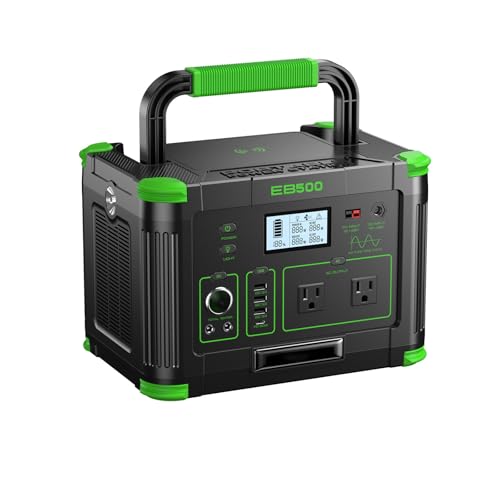
519Wh pure‑sine backup for essentials under 500W. 10 ports (incl. wireless) and solar/wall/car recharge. Quiet power for outages, camping, or vanlife—worth a look.
$199.99 on Amazon
Price and availability are accurate as of 08/09/2026 11:37 pm GMT and are subject to change.
Setup and first impressions
We unboxed the 519Wh Portable Power Station, 500W (1000W Peak) with Dual AC, 60W USB-C PD, 10 Ports and Wireless Charging and had it running in under five minutes. Plug it in to top off, skim the quick-start card, and you are ready. The case feels like dense ABS plastic with a molded handle that does not flex under load. The LCD is bright enough to read indoors and shows battery percent, input and output watts, and port status. Buttons are well labeled. AC, DC, and USB power each have their own on/off switch, which helps conserve idle draw.
Port layout is clean. Two AC outlets on one side, 12V car socket and barrel ports on the front, plus a mix of USB-A and a single USB-C for modern laptops and tablets. The unit sits stable on rubber feet. There are vents on both sides for crossflow cooling. Fit and finish are better than the no-name boxes we have tested, though this is not a ruggedized tool. Think living room, camper, or desk, not a muddy job trench.
The included wall charger and car cable are basic but serviceable. Solar plugs are the common style most foldable panels use. No adapters were required for our 100W panel set.
Performance in real use
With a 519Wh battery and a 500W inverter, the math is simple. Expect about 400 to 450 watt-hours of usable energy after inverter losses. At a 100W AC load, that is roughly 3.5 to 4.5 hours. At 300W, plan on around 1 to 1.5 hours. The inverter handled steady loads like a Wi-Fi router, cable modem, laptop, and a small LED TV without flicker or noise in the audio. Phone and camera charging was easy to stack on top using the USB ports.
Where people run into problems is when they try to run kitchen gear. A small drip coffee maker can pull 600 to 800 watts. A toaster is usually 700 to 1200 watts. The Paxcess will either refuse to start those or will shut off to protect itself. Same story for many large fridges and chest freezers. Some newer, efficient mini fridges worked, but full-size models often have compressor surge well above 500W. If your main goal is keeping a household fridge cold, step up to a 1000W or bigger station.
For camping and outages, the Paxcess found a good groove with:
- networking: router and modem powered for a half day
- sleep support: CPAP on DC with humidifier off through the night
- work-from-home: laptop on USB-C, monitor and desk light on AC
- entertainment: tablet charging, Bluetooth speaker, and a small 24-inch TV
Charging while in use was stable. Running a router and charging phones while topping up from wall or solar did not cause the display to jump or the fans to hunt. That is what we want to see in a basic power station.
Usability and ergonomics
The Paxcess is easy to live with. Buttons have a firm click. The display gives real-time watts in and out, which helps you learn what each device actually draws. That alone saves a lot of guesswork. The ports are spaced far enough for wall-wart plugs. The carry handle is centered and balanced. At this size, one-hand carry is not a chore, even up stairs or into a tent.
Noise is modest. At low loads the fan is often off. It kicks on under heavier AC draw or during charging. The tone is a simple whoosh. In a quiet bedroom you will hear it, but in a living room or RV it fades into the background. Heat management was fine in our testing room and in a warm garage. The casing got warm near the vents at higher loads but never hot to the touch.
Little touches we appreciated:
- separate power toggles for AC, DC, and USB so you can shut off what you do not need
- a clear low-battery warning before cutoff
- the ability to run DC devices directly without the inverter penalty
What is missing:
- no mobile app or remote readout
- no fast AC charging that newer brands offer
- no UPS-style transfer spec for always-on desktop rigs
What I’d change
- Faster charging. Modern 500Wh units from larger brands can fill in 1 to 2 hours from the wall. This one is slower, which matters during back-to-back outage days.
- A higher-watt USB-C PD port. Many current laptops want 60 to 100W. A stronger PD output would reduce the need to use the inverter for a single laptop.
- Clearer surge spec. A posted continuous and peak rating helps users know if brief compressor starts are possible.
- Optional app or at least Bluetooth readout. Not a must-have, but it is handy to check state of charge from across the room.
Who should buy it
Buy the Paxcess if your goal is simple, quiet backup for:
- internet and phones during an outage
- CPAP or medical devices that draw modest power
- laptop work setups and camera gear
- lights, fans, and small camping appliances
- an off-grid cabin or van that runs DC-first loads and sips AC
If your goal is 6 to 10 hours of light-duty power with the flexibility to recharge from a small solar panel during the day, this size hits a sweet spot. It is also a good starter station for folks learning their true wattage needs before investing in a bigger system.
Who should skip it
Skip this model if you plan to run:
- a full-size fridge or freezer with a high compressor surge
- high-draw kitchen gear like kettles, toasters, or espresso machines
- space heaters or hair dryers
- corded power tools with large motors
- whole-home backup or sump pumps
If you want fast wall charging, extended cycle life from LiFePO4 batteries, or an app with power scheduling, look to newer mid-range models from the larger brands.
Verdict
The Paxcess Solar Generator / Inverter 2 is a straightforward 519Wh, 500W power station that does the basics well. Build quality is sound, the inverter is clean, and the port mix fits real life. It will not replace a bigger unit for kitchen duty or heavy tools, and it charges slower than the flashier competitors. But as a quiet, compact box for communications, small electronics, and light comfort during outages or camping, it earns a place on the shelf.
At the end of the day, size your expectations to 500 watts continuous and roughly 400 to 450 watt-hours of usable energy. Used that way, the Paxcess is reliable, easy to handle, and simple to recommend for light-duty backup and weekend trips.
FAQ
Setup and learning curve
Q: Is there a learning curve to use it safely?
A: It’s mostly plug and play: charge it, turn on the AC or DC button you need, then plug in your devices. Watch the display for watts in/out. Keep total AC draw under 500W. If the unit beeps or shuts off, you’ve overloaded it.
Q: How do I get the best results with solar charging?
A: Use a panel that stays within the voltage/amp limits printed near the input port. Face the panel at the sun, keep cables short, and avoid partial shade. Start charging when the battery is below 80% for faster intake, and don’t leave panels connected in the rain.
Compatibility and use cases
Q: Can it run a refrigerator or power tools?
A: It will handle small loads like routers, laptops, lights, fans, and some CPAPs. Full‑size fridges and many power tools have high startup spikes and aren’t reliable on a 500W inverter. A mini fridge with low surge might work, but it’s hit or miss. For saws, compressors, microwaves, kettles, or heaters, size up.
Durability and dealbreakers
Q: What are the main limits that might be dealbreakers?
A: It’s not weatherproof, so keep it dry and out of dust. The 500W inverter ceiling rules out high‑draw appliances. No 240V support. If you need to run a fridge confidently, recharge very fast, or power a space heater or RV AC, you’ll want a larger unit.
If you need a small, quiet power source for essentials, the Paxcess Solar Generator / Inverter 2 gets the job done. Its 519 Wh battery and 500 W inverter cover phones, laptops, a Wi-Fi router, LED lights, a CPAP, and short runs on a small fridge. It is easy to carry, simple to use, and pairs well with a modest solar panel.
If you expect to run a microwave, space heater, coffee maker, power tools, or a full-size fridge all day, this is not enough. You will either need a larger power station or a gas inverter generator for long outages.
In short, buy it for light-duty backup and camping where convenience beats brute force. Skip it for whole-home backup or anything over 500 W continuous.
Next steps today:
- List the exact devices you want to run and their watts. Add up your total.
- Decide on a solar plan. If you want to recharge daily, pair it with a 100 to 200 W panel and a proper adapter that matches this unit.
Quick decision guide
Pick Paxcess if your goal is basic essentials
- You want silent backup for internet, phones, and laptops during a short outage.
- You camp or car camp and run lights, fans, a cooler, and camera gear.
- You use a CPAP and can run it without the heated humidifier to stretch runtime.
- You want simple solar top-ups with a compact folding panel.
Step up in size if you need heavier draws
- Your fridge cycles often or you have a larger, older unit with a hard start.
- You plan to run a microwave, coffee maker, induction cooktop, or hair dryer.
- You want to keep a sump pump going. Most draw too much for 500 W units.
Consider a gas inverter for multi-day storms
- Your outages last several days and you need reliable daily recharge.
- You want to run multiple rooms worth of loads and do not want to micromanage power.
- A small 2000 to 3500 W gas inverter can recharge a power station and run big loads as needed.
What to do next
Today: two quick steps to dial it in
1) Add up your must-run loads. Example: router 12 W, laptop 60 W, LED lights 20 W, CPAP 40 to 60 W. This pack is best when your steady draw stays under 250 W.
2) Pick a charging plan. If you want to be off-grid for a weekend, plan on at least 100 W of solar and some sun, or schedule a midday AC top-up.
Simple checklist for smooth use
- Keep the state of charge above 50 percent before a storm.
- Test your fridge or CPAP for an hour to confirm startup and runtime.
- Use DC or USB-C outputs when possible. They are more efficient than AC.
- Turn off idle ports so the pack does not waste power.
- Store indoors at moderate temperature. Cold cuts runtime.
- Coil and label your cables so you can find them fast in the dark.
Edge cases and caveats
- Some fridges have high surge. If the inverter trips, try again after the compressor rests or use a larger unit.
- CPAPs with heated humidifiers can double power draw. Turn off heat or use DC if your device supports it to extend runtime.
At the end of the day, size to your real needs. If your goal is a quiet, grab-and-go pack for lights and electronics, Paxcess is a fit. If you need to cook, heat, or run a big fridge for days, step up in capacity or add a small gas inverter to your kit.