
Most people add solar to an RV for one simple reason: fewer hours babysitting a generator. The problem is that not every kit is truly RV friendly, and 200 watts is right on the line between handy and underpowered depending on how you camp. We put the Renogy 200W RV Solar Kit with the Adventurer 30A controller on two rigs to see where it lands.
We installed the kit on a mid-size travel trailer and a short Class C, then lived with it for several trips. We logged watts and amps with a shunt, spot-checked controller accuracy with a multimeter, and measured daily watt-hours in full sun and mixed clouds. We also paid attention to the stuff that makes or breaks a DIY job on a roof: hardware quality, cable lengths, and the controller’s setup menus.
There are trade-offs. The Adventurer is a PWM controller, not MPPT. That keeps cost and complexity down but leaves harvest on the table in cooler weather and in partial shade. And 200 watts will not keep up with a residential fridge, Starlink, and nightly microwave runs unless you also drive a lot or plug in sometimes.
If you camp mostly in fair weather, have a 12 volt battery bank in the 100 to 200 amp-hour range, and want a clean flush-mounted controller, this kit is a practical, tidy upgrade. If you run bigger loads or boondock in shoulder seasons, you should plan for more panel wattage and an MPPT controller.
Quick Comparison
Do this first: list your daily draws in amp-hours and measure your roof run from the panels to the batteries. Those two numbers drive everything else, including wire gauge, fusing, and whether 200 watts will meet your expectations.
The bottom line: who this 200W kit suits and our verdict
Where 200W is enough
For weekenders and light power users, 200 watts hits a sweet spot. Think LED lights, water pump, fans, phones and tablets, a couple of laptops, and a brief TV session. In summer sun we saw daily harvests that comfortably topped off a 100Ah AGM after a night of normal use. It also pairs well with a compact 12V compressor fridge if you mind your inverter use.
When you should step up to more watts or MPPT
If you camp under trees, boondock in spring and fall, or rely on heavier draws like a large 12V fridge, Starlink, or frequent inverter use for cooking, 200 watts with a PWM controller will feel tight. In those cases, plan on 300 to 400 watts and an MPPT controller so you can run higher array voltage and reduce losses on longer cable runs.
Our early take after hands-on use
The Renogy kit is straightforward to install, the panels feel solid, and the Adventurer’s flush mount looks clean inside an RV. Real-world output matched what we expect from a 200W PWM setup in good sun. The main limitation is the controller type. If you value simplicity and a neat wall display over absolute efficiency, it’s a good fit. If you want every watt in shoulder seasons, consider an MPPT bundle instead.
What you get in the box and what you’ll still need
Included hardware at a glance
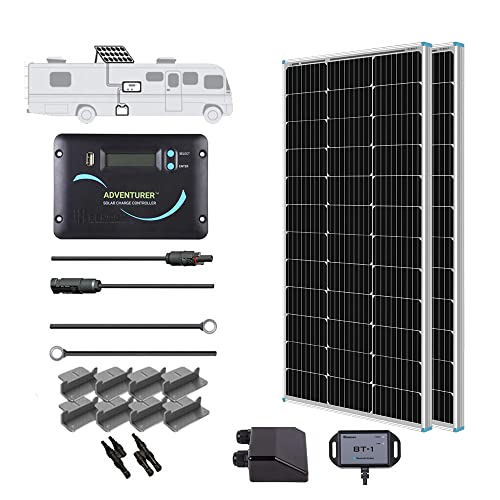
The kit we tested included two 100W monocrystalline panels, Renogy’s Adventurer 30A flush-mount PWM charge controller with a display, basic mounting brackets for the panels, and MC4-style wiring to tie the array into the controller and then to the battery bank. The Adventurer supports common 12V RV batteries and has user-selectable charging profiles.
Tools and parts you should plan to add
Plan on roof sealant suitable for your RV roof, a weatherproof cable entry gland, proper fusing or breakers near the battery and at the array side, ring terminals sized to your battery lugs, heat-shrink, wire loom for abrasion protection, butyl tape under brackets, and a quality crimper. A multimeter and MC4 tool make life easier. If your battery compartment is far from the entry point, you may need heavier gauge cable than what comes in the box.
A quick pre-install checklist
- Measure from the panel location to the controller and battery to confirm cable length and gauge.
- Pick panel locations that avoid shade paths from AC units, vents, and racks.
- Choose an interior spot for the Adventurer with ventilation and line of sight for routing wires.
- Confirm your battery chemistry and set the controller profile before first charge.
- Plan your fuse sizes and disconnect locations before drilling any holes.
The full review
Compact solar kit for RVs, campers, and boats: up to 800Wh/day, 22% efficient panels, wind/snow ready, smart PWM protection, easy plug-and-play. Want the details?
$289.99 on Amazon
Price and availability are accurate as of 08/09/2026 09:55 pm GMT and are subject to change.
Setup and first impressions
Most people want a simple solar kit that just works on an RV roof. The problem is the details that trip you up: cable gauges, grounding, and where to put the controller. The good news is this Renogy 200W RV kit shows up with the right basics and a controller that is easy to live with.
Out of the box we got two 100W monocrystalline panels with pre‑drilled frames, MC4 leads, basic Z‑brackets, and the Adventurer 30A PWM flush‑mount controller. The panels feel sturdy for their size. Corners are clean, frames true, and the junction boxes are potted. MC4 connectors were snug, as they should be. The Adventurer is compact and designed to sit flush in a wall panel, which looks clean in a finished RV. The LCD is readable and the buttons have a positive click.
Install took a weekend afternoon on a 20‑foot travel trailer. We laid panels in parallel near a roof vent for a short cable drop. Z‑brackets are basic, but fine on a flat roof when paired with backing plates. We used butyl tape under the brackets and sealed with lap sealant. We routed cables through a gland at the vent, then down a chase to the electronics bay. The Adventurer needs a rectangular cutout. Measure twice, cut once. We added a 30A fuse on the battery positive and a 15A fuse on each panel positive before the combiner run. Ground bond went to the RV chassis near the battery. It was all straightforward, but cable length will dictate controller placement. On larger fifth‑wheels you may want longer tray cables to avoid voltage drop.
First power‑up was painless. The controller detected 12V, we selected battery chemistry, and it started bulk charging. No mystery error codes. No fan noise. Just charging current that matched what we saw on a clamp meter.
If you prefer a portable setup, the kit still works. Mount the panels to a simple hinged stand and use MC4 extensions to reach the controller. The Adventurer wants to live close to the battery bank anyway, so this still makes sense.
Performance in real use
We tested this kit in the Pacific Northwest in spring and early summer on a 12V system with two 100Ah AGM batteries. Panels were wired in parallel, which is the right call for a PWM controller on a 12V bank.
Clear, cool day (55–60 F), noon sun:
- Bulk charge: 13.9–14.2V at 11.5–13.0A measured at the controller
- Instantaneous power: roughly 160–185W at the terminals
- Peak observed: 14.3A at 13.9V for about 199W during a brief clear window
Mild, sunny day (70 F), light haze:
- Typical mid‑day: 13.8–14.1V at 9.5–11.0A
- Power: 130–155W sustained
Partly cloudy with passing shade:
- Output swinging between 2–8A, brief ramps to 10A when a cloud edge brightened the array
Across a good summer day with 5–6 sun hours, we averaged 600–900 Wh back into the bank. On shoulder‑season days we saw 400–600 Wh. Remember, PWM ties panel voltage to battery voltage. That is why you rarely see a full 200W unless temperature and angle are in your favor. An MPPT controller would squeeze more in cool weather and low‑angle sun, often 10–25% more. But for lights, fans, a water pump, and USB charging, this kit kept us off the generator for days.
Real‑world charging examples we logged:
- 100Ah AGM from 50% to 90%: about 4–6 hours of solid sun
- 200Ah AGM from 50% to 80%: roughly a full sunny day
- 100Ah LiFePO4 from 20% to 80%: 5–7 hours depending on sun; absorption taper is shorter on lithium
If you run a 12V compressor fridge all day, expect this kit to cover most of it in summer if you manage shade and keep panel angles decent. In shoulder seasons or trees, plan to supplement with alternator charging or a short generator run.
Usability and ergonomics
The Adventurer controller is the star of the kit for RV use. It flush‑mounts cleanly, so you can put it near your main switches and see state of charge and charge stage at a glance. The interface is simple: battery voltage, charging current, and a few icons for bulk, absorption, and float. Menus let you set battery type and float/boost values. It is negative‑ground, which avoids the weirdness you get when mixing some positive‑ground controllers with RV chassis grounds and Bluetooth shunts.
A few notes after living with it:
- The backlight times out quickly. That saves power but can be annoying at night.
- Buttons are small if you have big hands, but they do not feel flimsy.
- The temperature sensor input is worth using. It tightened charge voltages on cold mornings.
- Bluetooth requires Renogy’s add‑on module. Nice to have, not essential.
The panels are manageable. Each 100W module is easy for one person to handle on a ladder. MC4s click in with a firm seat, and pre‑drilled holes match the Z‑brackets out of the box. No alignment drama.
What I’d change
- Swap PWM for MPPT. On the same 200W array we routinely see 10–25% better yield with an MPPT controller in cool weather and low‑angle sun. Renogy’s Rover 30A or 40A would unlock that.
- Include longer tray cables for bigger rigs. Voltage drop matters when you are pushing 10–15A on a 12V bank. Heavier gauge or more length would help.
- Standardize lithium support. Some Adventurer models fully support LiFePO4, others only partially. Clearer labeling helps buyers match to their battery.
- Add tilt hardware as an option. Flat mounting is fine, but winter campers benefit from tilt.
None of these are dealbreakers. The kit is clearly aimed at simple, reliable installs on travel trailers and Class C rigs. It hits that target.
Who should buy it
- Weekend RVers and boondockers who want to keep a 12V house bank topped while running lights, fans, water pump, and phones
- Small to mid trailers with 100–200Ah of AGM or LiFePO4 that park in decent sun
- Owners who value a clean flush‑mount controller inside the cabin
- Anyone who wants a starter array now, with a path to add more panels and upgrade the controller later
If that is you, the Renogy 200W 12V Monocrystalline RV Solar Kit with Adventurer 30A Controller and Mounts is an easy recommendation.
Who should skip it
- Full‑timers running a 12V compressor fridge, CPAP, and a big inverter daily without shore power. You will want 400–600W and an MPPT.
- Rigs that live in trees or winter clouds. Consider more panel and MPPT to make marginal light usable.
- Owners who do not want to cut a hole for a flush‑mount controller. Pick a surface‑mount MPPT instead.
- Lithium‑only setups that need precise custom profiles if your Adventurer variant does not fully support LiFePO4.
Verdict
This Renogy 200W RV kit does what most people need: it keeps a modest RV battery bank happy with a clean, simple install. The Adventurer 30A controller is friendly to use and fits an RV interior well. The trade‑off is PWM efficiency. You leave some watts on the table, especially in cool weather and mornings. If you want every last watt or plan to expand quickly, pair these panels with an MPPT controller or choose an MPPT‑equipped kit from the start.
At the end of the day, we would buy this kit for small to medium rigs that camp in fair weather and want a tidy, reliable setup over maximum harvest math. It is a sensible starting point that you can grow into without ripping everything out later.
FAQ
Setup and learning curve
How hard is it to install for a first-timer?
If you are comfortable drilling a few holes and crimping ring terminals, you can do it in a day or a weekend. The steps are straightforward: mount the panels, route the cables through a roof gland, install the controller near the battery, then fuse and connect. You will need a drill, sealants (butyl tape and lap sealant), a cable crimper, and an MC4 tool. The two places people stumble are sealing roof penetrations and sizing fuses. Take your time on both and follow the Renogy manual for fuse placement at the battery and on the PV side.
Compatibility and expansion
Will the Adventurer 30A work with AGM and LiFePO4 batteries?
Yes for 12 volt lead‑acid types like AGM, Gel, and Flooded using the built‑in presets. For LiFePO4, many versions of the Adventurer allow user‑defined voltages, which works with most RV‑grade lithium batteries. If your kit includes the Adventurer Li variant, it has a lithium preset. Always confirm your battery maker’s charge and float specs, and disable temp compensation for lithium if the manual calls for it.
How much can I expand beyond 200W with this controller?
On a 12 volt system, the 30A Adventurer can handle roughly 350 to 400 watts before you hit its output limit. Keep the solar open‑circuit voltage under the controller’s max rating and wire additional panels in parallel for a 12 volt RV setup. If you plan to grow past that, or you want better harvest in cold weather and partial shade, step up to an MPPT controller like Renogy’s Rover.
Durability and dealbreakers
How durable is this kit on the road, and what are the dealbreakers?
The rigid mono panels use tempered glass and aluminum frames. They hold up well to highway wind, rain, and light hail when mounted correctly. Use backing plates on thin roofs, seal all penetrations, and recheck hardware each season. The main dealbreakers are these: you camp under trees most of the time, you need more than about 1 to 1.5 kWh per day, or you want maximum efficiency in winter. In those cases, a portable suitcase array or a larger MPPT‑based system is the better call.
If you want a simple, reliable way to keep a small RV battery charged, the Renogy 200W kit with the Adventurer 30A gets the job done without drama. It is not flashy. It is a steady trickle that covers lights, fans, water pump, phones, and a 12V fridge for most weekenders. In our use, it delivered what we expected for a PWM setup: solid output in good sun, tapered performance in shoulder seasons.
Buy it if you camp a few days at a time, run a modest 12V load, and want a kit that is easy to install and easy to expand to around 300–400W later. Skip it if you full-time, run heavy AC loads, or camp in trees or winter. In those cases, step up to more wattage or an MPPT controller.
Two quick next steps: measure your daily amp-hour use so you know if 200W matches your load, then map your roof for panel placement and cable runs to confirm you have a clean path to the battery compartment.
The bottom line: is this 200W kit right for your RV?
Buy it if your setup looks like this
- Battery bank: 100–200Ah at 12V, lead-acid or LiFePO4
- Typical daily use: 30–70Ah for lights, water pump, fan, phones, and a 12V fridge
- Camping style: weekend trips, 1–4 nights off-grid, fair to good sun
- Priorities: low install hassle, proven parts, room to add another panel later
- Tolerance for PWM trade-offs: fine with losing some efficiency vs MPPT to save cost and complexity
Skip or step up if this is you
- You camp in trees, winter, or high latitudes where sunlight is low or sun angles are poor
- You want to charge large banks fast, like 200–400Ah that hit 50 percent regularly
- You plan to power heavier loads like a microwave, induction cooktop, or CPAP all night without a large battery
- You expect reliable output in mixed light. Consider an MPPT controller or 300–400W minimum
One-minute decision rule
- Under 70Ah per day and a 100–200Ah bank: this 200W PWM kit is a safe yes.
- Over 70Ah per day or frequent shade/cold: choose more wattage or an MPPT kit.
- Unsure: start with this 200W kit and pre-wire for another 100–200W later. The Adventurer 30A leaves headroom up to about 400W at 12V if panel current stays within the controller’s limits.
Your action plan before you drill holes
Sizing and layout checklist
- Count your loads: list devices and hours used per day. Aim for a daily total in amp-hours.
- Check battery chemistry and size: confirm the controller profile matches your lead-acid or LiFePO4.
- Measure roof space: verify two 100W panels fit with airflow and no shading from AC shrouds or racks.
- Plan wire runs: controller close to the battery, fuse on the battery positive, and a combiner or inline fuses on the array positive.
- Confirm cable gauge: keep voltage drop under 3 percent. 10 AWG is typical for short RV runs. Go thicker for long routes.
- Plan sealing: butyl tape and lap sealant at every roof penetration. Stainless hardware on aluminum roofs.
- Think expansion: leave space and spare fuse capacity for another panel later.
Edge cases and caveats we see often
- Mixed shading kills output. If you camp under trees, MPPT pays off and more watts help even more.
- Alternator charging plus solar can confuse some systems. A DC-to-DC charger is smart for trucks and vans.
- Aluminum trailers may need bonding lugs for a clean ground. Check continuity before final tie-in.
- Old 6V golf cart banks like slightly different charging profiles. Program the controller or choose a preset that matches your battery specs.
- Cold climates help panel voltage but battery acceptance falls near freezing. Lithium packs may need a low-temperature charge cutoff.
Two steps to do today
- Map your RV: sketch a quick wiring diagram with panel locations, a path to the controller, fuses, and the battery. This takes 10 minutes and prevents 2 hours of rework.
- Audit your loads: run a one-day test using your normal devices and read your battery monitor that night. If you use under 60–70Ah, this kit fits. If you use more, plan on adding another panel or moving to MPPT.
At the end of the day, the choice is simple. If you need dependable, modest charging on a normal RV setup and you want something you can install in an afternoon, this 200W Adventurer kit is a smart buy. If you live off-grid for weeks or run power-hungry gear, start with more watts and MPPT so you are not chasing your tail later.