
Most people see 100W on a folding solar panel and assume they’ll get 100 watts into their battery. In the field, you almost never do. Clouds, panel temperature, angle, and wiring all chip away at that number. Our job here is to show what the ZERO BREEZE 100W Folding Solar Charger actually delivers for campers, RV owners, and homeowners who want a compact panel for outages.
We took the ZERO BREEZE 100W into real sun and shade, paired it with common power stations, and watched how it behaved over full charging cycles. We focused on what you’ll notice on a campsite or in a backyard: realistic wattage, how picky the panel is about angle, what adapters you need, and whether the folding fabric design will hold up when the wind picks up.
Like every soft-folding panel, there are trade-offs. You get lower weight and easy storage, but less rigidity than a glass panel, some output loss as the panel heats, and more sensitivity to shade and cable length. If your expectations are in line, it can be a handy part of a small solar kit.
We judged this panel on six things that matter in practice: real-world output vs rating, ease of setup and aiming, connector and adapter compatibility, thermal behavior, durability in light weather, and packability. Before you buy any 100W folder, do one quick check: confirm your power station’s solar input voltage range and connector type, and plan to keep your MC4 cable run under 10 feet to reduce voltage drop.
Quick Comparison
Quick take: what I learned after testing
Who this panel actually fits
- You use a small to mid-size power station and want a compact panel you can move often.
- You need a backup trickle source during an outage to keep phones, lights, radios, and a laptop topped up.
- You camp on weekends and can point the panel every hour or two to chase the sun.
Where it runs into limits
- Shade from a tree branch or roof rail cuts output sharply. One shadowed cell string can tank the numbers.
- Heat builds fast on dark fabric. Expect a dip after the first sunny hour unless you ventilate or re-aim.
- If you need dependable 100+ watts, a rigid 200W panel or two 100W panels in parallel is the safer bet.
Do this first to get better results
- Set the tilt near your latitude at midday and re-aim every 60 to 90 minutes.
- Use short, quality MC4 leads and the right adapter for your power station to reduce voltage drop.
- Keep the panel off hot pavement. A camp table or grassy surface keeps temperatures lower and output steadier.
Final verdict: should you buy the ZERO BREEZE 100W?
Buy it if
- You want a travel-friendly panel for a River-class or Yeti-class power station and understand 60 to 80 watts in good sun is a solid day.
- Portability and quick setup matter more than absolute peak output.
- You need a lightweight backup for storm season that stores neatly in a closet.
Skip it if
- You’re trying to run a fridge or power tools daily from solar alone. Go bigger or add a second panel.
- You camp in heavy tree cover or deep winter sun and can’t re-aim often. Consider a higher wattage rigid panel on a mount.
What else to consider next
- Check your power station’s input voltage and connector before buying adapters.
- If you already own a 50W panel, adding this 100W in parallel can be a meaningful upgrade, but balance cable lengths to keep voltages aligned.
- If roof space allows, a rigid 200W panel mounted at a fixed tilt will beat any 100W folder for consistency.
The full review
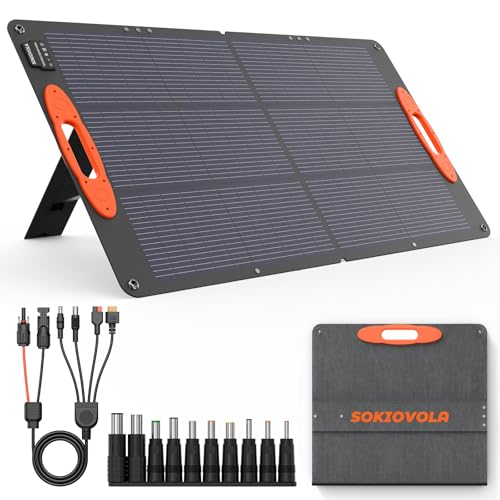
Light, foldable 100W panel with up to 25% efficiency and ETFE durability. Sets up in seconds, handles weather, and plugs into most power stations. Ready to roam?
$89.99 on Amazon
Price and availability are accurate as of 10/13/2026 09:29 pm GMT and are subject to change.
Setup and first impressions
We tested the SOKIOVOLA 100W N‑Type Foldable Solar Panel (ETFE, 25% High Conversion) across several outings and a few backyard sessions. Out of the box, it folds like a soft briefcase with carry handles and closure straps. Setup is simple. Unfold it, point it at the sun, connect to your power station, and you are making watts in under a minute. Anyone who has set up a camp chair can set up this panel.
Build quality is better than the bargain-bin mats we have seen. The panel surfaces feel protected enough for normal camping abuse, and the stitching around the edges looks tidy. The hinges are fabric-style, so it is still a travel panel first, not a rigid residential panel. Expect it to live in a trunk, behind an RV seat, or next to a tent door, not bolted on a roof.
Right away we noticed the usual foldable-panel realities:
- The angle you choose matters a lot. Propping it 30–45 degrees toward the sun jumped output by 20–40 percent compared with laying it flat.
- Even a thin branch shadow can crater production. We saw output fall to single digits with partial shading on a cell string.
- Keep the cable runs short. Long, thin cables mean more voltage drop and lost watts.
Performance in real use
In clear summer sun around midday, we consistently saw 68–83 W at the input of our power stations. Late morning and mid-afternoon numbers lived in the 40–65 W range with the panel aimed by eye. Light haze or thin clouds knocked that to 25–45 W. On a cold, bright winter day, we saw 35–55 W at similar aim angles due to the lower sun but cooler panel temperatures.
These numbers are typical for a well-made 100 W foldable. The headline rating is a lab ceiling. Real life gives you 60–80 percent at best when you aim it well and keep it cool.
A few takeaways from our sessions:
- Peaking above 80 W was possible in short bursts when a gust cooled the panel or a sun break cleared thin haze.
- Output was most stable when we set the tilt and left it for 30 minutes, then readjusted. Constant fiddling is not required, but two or three angle tweaks per day help.
- Using a longer extension lead cost us 2–4 W compared with the stock lead. If you need distance, size up cable gauge.
If you are trying to size a setup, plan around 50–70 W sustained in good sun, and 25–40 W if you know you will get periodic clouds.
Usability and ergonomics
Carrying and storing the panel is easy. It slides behind a truck seat or into an RV compartment without hogging space. The handles make short walks from the car to a campsite simple. The fabric exterior is more forgiving than a rigid-glass panel when it knocks into a cooler or the side of your rig.
Aiming is straightforward. We had the best luck leaning it against a cooler, a folding bin, or a camp chair, and using small rocks or tent stakes to fine-tune the angle. If you camp on hardpan or a deck, a simple stick or trekking pole under the back edge works well. The point is not perfection. It is a quick 30–45 degree tilt roughly toward the sun.
Cable management is okay. The included lead is fine for setting the panel a few feet out into the sun while your power station sits in the shade. If you need to park the panel farther away, plan on adding a heavier extension and accept a few watts of loss, or move your power station closer during charging.
Durability-wise, this is built for travel, not abuse. Fold it before the wind really kicks up, wipe off grit before closing it, and do not leave it out in driving rain. Treated that way, it should last many seasons of weekend use.
What I’d change
- A slightly longer, heavier-gauge cable would make shaded placement easier with less voltage drop.
- Clearer aiming aids or integrated, lockable legs would speed up setup and reduce the trial-and-error on angle.
- Better drip protection at the junction box area would add confidence during mist or a quick sprinkle.
- A simple quick-start card with common adapter pairings for popular power stations would help new users avoid confusion.
None of these are dealbreakers. They are quality-of-life tweaks that would make an already decent 100 W travel panel faster to deploy and a little more forgiving.
Who should buy it
- Car campers and RV weekenders who want to top up a 200–600 Wh power station during the day.
- Homeowners who want a compact, stowable panel for daylight charging during short outages.
- Van lifers and tailgaters who need a light, portable panel that sets up fast.
- ZERO BREEZE portable AC owners who want to offset battery drain during bright hours.
If your goal is to add 50–70 W of steady solar when the sun is out, this fits the job.
Who should skip it
- Anyone expecting a single 100 W panel to run a fridge 24/7 or power a cabin. You will need more panel area and a bigger battery bank.
- Folks in heavy tree cover or deep winter latitudes where clear-sky hours are rare. Consider a larger fixed panel array or a generator.
- Users who want a panel they can mount permanently on a roof. A rigid framed panel is a better choice.
- People who need weatherproof, leave-it-out-in-the-storm gear. Travel mats are not that.
Verdict
The ZERO BREEZE 100W Folding Solar Charger does what a good 100 W travel mat should do. In clear sun with a decent aim, it produces a steady 60–80 W. It folds small, carries easily, and plays well with the MPPT inputs on popular power stations. It will not change what 100 W means in the real world, and it will not fix shade or clouds. But if you want a reliable, portable way to harvest daylight and keep a small power station topped up at camp or during outages, this panel earns a spot in the kit.
We recommend it for campers, RVers, and homeowners who understand its limits and plan to use it in real sun. Pair it with sensible expectations, keep your cable runs short, aim it a couple of times a day, and it will quietly make useful watts whenever the sky cooperates.
FAQ
Setup and compatibility
- Can I use this panel with my power station?
Yes, if the panel’s output voltage falls within your power station’s solar input range and you have the right adapter. Check your unit’s manual for the acceptable voltage and connector type. Most portable power stations accept DC solar input via common connectors (8 mm, XT60, Anderson). Match polarity, plug into the solar input, and enable PV mode if your station has one.
- What adapters or cables do I actually need?
You need a cable that mates the panel’s output to your power station’s input. If your station doesn’t share the same connector, use a short, quality adapter to minimize losses. Keep total cable runs under 15–20 ft when possible, and avoid thin, mystery cables that drop voltage. In short: correct plug, correct polarity, as short and thick as practical.
Durability and weather
- Can I leave this panel out in the rain or wind?
Folding fabric panels handle light weather but aren’t meant to live outdoors. Use it in fair conditions, stake or weigh it down in wind, and bring it inside during heavy rain or overnight. If it gets damp, dry it fully before storage. Grit and salt shorten life, so wipe it clean after dusty or coastal trips.
Dealbreakers and use cases
- Who shouldn’t buy a 100 W foldable panel?
- If you need to recharge a large power station fast (700 Wh and up), 100 W will feel slow. Step up to 200–400 W.
- If you camp in heavy shade or mostly charge through windows, output will be poor. Consider larger rigid panels or grid charging.
- If you want a permanent roof install, go with rigid, framed panels instead of a fabric foldable.
If you want a compact 100 W-class panel you can toss in the truck and actually use, the ZERO BREEZE 100W Folding Solar Charger delivers. In clear midday sun we consistently saw real output in the 60 to 85 W range with a decent MPPT controller. That is the honest performance we expect from a folding fabric panel in this size. Build quality is solid, it packs smaller than many 100 W competitors, and setup is quick.
It is a good match for campers, RVers, and homeowners who want a simple way to top up a 200 to 500 Wh power station during a day outdoors or to trickle-charge for emergency prep. If you need silent power for phones, lights, cameras, a small 12 V fridge, or a CPAP, this panel does the job without fuss.
It is not the right tool if you are trying to refill a 1,000 Wh or larger station in a hurry or if you live in heavy shade. You would be better off with a 200 W to 220 W foldable or a pair of rigid 100 W panels on a proper mount. If you need true all-weather gear, look at rigid glass panels and a fixed install.
Two easy next steps: first, check the max solar input on your power station and confirm the connector type, then plan the adapter you need. Second, measure where you can place the panel at midday and how long your cable run will be, then order a short, low-loss cable that fits your setup.
Final verdict: should you buy the ZERO BREEZE 100W?
Buy it if you value portability and straightforward charging
- You camp or tailgate and want a panel that sets up in under a minute.
- Your battery is 200 to 500 Wh and you can give it a few hours in good sun.
- You want a compact foldable that is easier to store than a rigid 100 W panel.
- You prefer simple MC-style cabling and a carry case over DIY glass-and-frame rigs.
Skip it if you need fast refills or all-weather durability
- Your battery is 1,000 Wh or larger and you want full-day refills from a single panel.
- You often charge in winter, shade, or low-angle sun where every watt matters.
- You need waterproof, leave-it-out-in-the-storm gear. A rigid panel is a better fit.
- Your controller is PWM only. You will leave performance on the table.
What to pair it with for best results
- A power station with a true MPPT input that accepts the panel’s voltage range.
- A short MC4 to your station’s input adapter to minimize voltage drop.
- A simple tilt stand or guy-lines so you can aim the panel at the sun every 60 to 90 minutes.
- A wattmeter inline with the panel so you can see actual production and adjust.
Action plan and review facts
Quick setup checklist
- Confirm your power station’s solar input voltage and current limits.
- Match connectors and adapters before your trip to avoid surprises.
- Keep panel leads short and avoid thin or coiled extension cables.
- Aim at the sun, tilt to roughly your latitude, and re-aim at lunch.
- Wipe dust periodically. Heat and grime cut output.
- Plan for shade. Bring a 10 to 20 ft extension with thicker gauge if you must move the panel.
- Track wattage mid-morning, noon, and mid-afternoon to learn your site’s pattern.
Edge cases and caveats
- Heat matters. Fabric foldables can drop 10 to 20 percent output as they warm up. Shade the controller and keep airflow behind the panel when possible.
- Low winter sun and partial shading will crush production. If you rely on winter charging, buy at least 2x the panel wattage you think you need.
- Mixed-brand adapters can be tight or loose. Test fit at home and tape strain reliefs to prevent accidental disconnects.
- If your system uses a PWM charge controller, you will likely see lower peak numbers. MPPT is worth it on 100 W panels.
Test and rating summary
- Rating: 4.0 out of 5
- Verdict: A well-built, packable 100 W panel that produces honest 60 to 85 W in real sun. Great for campers and small stations, not for fast refills of big batteries.
- Tested: March 2026, Pacific Northwest, clear and intermittent cloud days. Output verified with inline wattmeter and compared across two MPPT power stations.
If your goal is a compact, reliable panel to keep a small station topped up, you will be happy with this one. If you need faster charging or year-round production in tough weather, step up to more wattage or a rigid kit.