
If you want quiet, clean backup power without hauling gas, a DIY solar generator kit is the way to go. In plain terms, that means either a portable power station paired with solar panels or a simple component stack you wire yourself. Both give you stored energy you can recharge from the sun or the wall. No fumes. No weekly carb cleanouts.
Who benefits most: campers and overlanders who want power on the go, RV owners who boondock, homeowners who want to keep a fridge, lights, and phones running during outages, and off-grid hobbyists who like to tinker. If that sounds like you, this guide will help you choose the right path and avoid paying for features you will not use.
What matters most is straightforward. Enough battery capacity to cover your daily watt-hours. A pure sine inverter with the continuous wattage to run your biggest device. Fast, flexible charging with a proper MPPT solar input. Durable LiFePO4 batteries when possible. Clear expansion paths. Sensible weight and form factor.
Quick TL;DR picks by category:
Quick Comparison
- Budget portable kit: EcoFlow RIVER 2 Pro with a 160W portable panel
- Mid-range portable: Jackery Explorer 1000 Plus with one or two SolarSaga 200W panels
- Best component-based starter: Renogy 200W panels with a 40A MPPT, 100Ah LiFePO4, and a 1000W pure sine inverter
- High-capacity home-backup DIY: Victron Multiplus-II 12/3000 with SmartSolar MPPT, Battle Born LiFePO4 bank, and 800 to 1200W of PV
- Best for camping: Goal Zero Yeti 1000 Core with a Boulder 200 Briefcase
- High-capacity portable alternative: EcoFlow DELTA 2 Max with a 400W portable panel
A quick reality check. Solar is weather dependent. Expect slower charging in winter, clouds, or shade. Lithium packs do not like to charge below freezing. Big loads like electric kettles and microwaves drain small systems fast. Whole-home backup needs a transfer switch or interlock and usually an electrician.
Do this first: list what you actually need to power for 24 hours. Fridge, router, lights, phones, maybe a CPAP. Check the watt label on each device. Multiply watts by hours used to get watt-hours. Add 20 percent headroom. That number will steer everything else and save you from guessing.
Specs at a glance: how to read our comparison
Capacity and output in plain English
- Usable watt-hours: how much energy you can store. A 1000 Wh unit might run a 100 W fridge for about 7 to 8 hours of compressor-on time. Real runtime depends on duty cycle and inverter losses.
- Continuous watts: what the inverter can supply steadily. Match this to your single biggest device. If your fridge draws 120 W running but needs a 600 W start, get an inverter rated well above the running number, with a healthy surge rating.
- Surge watts: short bursts for starting motors. Helpful for fridges and power tools. Not relevant for laptops and lights.
Solar input and recharge speed
- MPPT vs PWM: MPPT squeezes more power in variable sun and higher panel voltages. It is what you want for efficiency and room to grow.
- Max solar watts and voltage window: tells you how many panels you can hook up and how you wire them. If you plan to expand, pick a higher input ceiling.
- AC recharge rate: faster wall charging is handy between storms and on trips.
Portability, expansion, and ecosystem
- Weight and handles: if you need to lift it alone, keep it under 40 pounds. Rolling cases help above that.
- Modular add-on batteries: easier scaling without a full rebuild.
- Ports you will actually use: 120V outlets, 12V regulated, USB-C PD for laptops, and an RV port if you have a travel trailer.
How to choose the right kit without overspending
Start with loads, not gear
- Separate essentials and power hogs:
- Essentials: fridge, lights, Wi-Fi, phone charging, CPAP.
- Power hogs: space heaters, electric water kettles, hair dryers, AC units.
- Tally your daily watt-hours. Size the battery to at least that number. Bigger is not always better if you cannot recharge it in a reasonable time.
Pick the right inverter and battery chemistry
- Pure sine inverter: keeps fridges and electronics happy. Skip modified sine.
- Battery type: LiFePO4 for long cycle life and stability. Lead-acid is cheaper upfront but heavier and shorter lived. Good for stationary builds on a tight budget.
Decide power station vs component build
- Power station kits: fastest to deploy, safer for beginners, great for camping and rentals. Limited deep customization.
- Component systems: more work but cheaper per watt-hour at scale. Easier to repair and upgrade. Demands basic wiring skills and proper fusing.
Where people run into problems is undersizing the inverter for motor loads, skipping fuses and disconnects, and expecting summer charging in winter conditions. Get the math close, protect your wiring, and plan a backup charging path like AC or vehicle when the sun does not cooperate.
1. Jackery Solar Generator 300 with SolarSaga 100W Air — 293Wh portable backup, 300W pure sine AC
Best Budget Portable Kit

Grab reliable off‑grid power: 293Wh, 300W pure sine, 7.1 lb. Recharges to 80% in ~2 hrs and runs up to 6 devices. Solar-ready with MPPT. Want a compact camp power pick?
Price and availability are accurate as of 10/13/2026 08:13 pm GMT and are subject to change.
Who this is for: campers, car campers, and anyone who wants a simple, affordable way to keep phones, lights, a small laptop, and camera batteries topped up. It is also a handy glovebox or closet backup for short outages when you just need light and communications.
Why we picked it: the mix of 293Wh capacity, a true 300W pure sine AC output, and the slim SolarSaga 100W Air panel hits the right balance of weight and usefulness. At 7.1 lb it is easy to carry. MPPT solar charging gets more from the panel, and it can recharge to 80% in around two hours, so topping off during lunch or between tasks actually works.
The trade-offs: 293Wh goes fast if you run AC loads continuously. Think essentials, not appliances. Space heaters, kettles, and hair dryers are off the table. If you want to run a fridge or power tools, you will outgrow this quickly and should step up to a mid-range unit or a component build.
Practical tip: stretch runtime by charging directly from the DC ports when possible and only switching on the AC inverter when you need it. Keep the power station shaded while the panel sits in full sun, and tilt the panel toward the sun to improve charge rate. You can check current pricing and specs at Jackery Solar Generator 300 with SolarSaga 100W Air — 293Wh portable backup, 300W pure sine AC.
2. OUPES Guardian 6000 Solar Generator Kit, 4608Wh, 6000W (7200W boost), 120/240V dual-voltage, 2x240W solar panels
Best Home-Backup DIY System
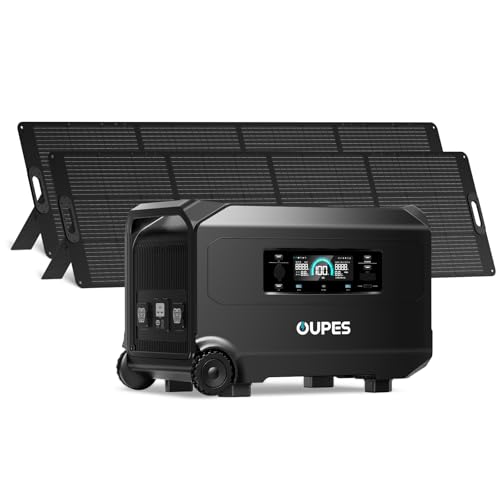
Turn outages into smooth sailing: portable 120/240V whole-home backup with UPS, app control, and room to expand. Includes panels—plug into transfer switch and go.
Price and availability are accurate as of 10/13/2026 10:06 pm GMT and are subject to change.
Who it’s for: homeowners who want quiet, gas-free backup that can run 120V circuits and 240V essentials like a well pump or mini-split, all from one box. Also a fit for renters or small businesses that need portable split-phase power they can tie into a transfer switch.
Why we picked it: there aren’t many portable kits with true 120/240V output, a stout 6000W inverter, and built-in UPS. This one checks those boxes and includes two 240W panels so you can start charging on day one. App control makes it easy to see state of charge and tweak settings. If you want a portable split-phase backup without gas, the OUPES Guardian 6000 Solar Generator Kit, 4608Wh, 6000W (7200W boost), 120/240V dual-voltage, 2x240W solar panels is one of the few kits that can feed a 240V transfer switch.
The trade-offs: 4608Wh is solid, but at 6000W you can drain it fast. The included 480W of solar is a starter, not a full-time refuel plan. Expect to add more panels if you want daily recharge during longer outages. It’s also heavy, and tying into a home requires a proper transfer switch and safe wiring.
Practical tip: make a short essentials list and power only those circuits: fridge, lights, internet, gas furnace blower, well pump if needed. Set UPS mode, label the backed-up circuits, and do a dry run. For resilience, aim for 800 to 1200W of total solar so you can recover a meaningful chunk of the battery each day.
FAQ
Setup
How long will a 1000 Wh kit run a fridge?
- Quick math: hours = Wh divided by watts. A modern 18-cubic-foot fridge averages 60-120 W. 1000 Wh divided by 90 W is about 11 hours. Subtract 10-15% inverter losses. Expect 8-10 hours without solar. With 200 W of panels in good sun, you may break even midday and stretch runtime across a day. Bigger or older fridges draw more.
Can I charge from solar while using the inverter?
- Yes on most systems. The controller charges the battery while the inverter pulls from it. If the load exceeds solar input, the battery still drains. Stay under the charge controller and inverter limits. Never backfeed a home circuit without a transfer switch.
Troubleshooting
My panels are in sun but charging is low or zero. What should I check?
- Verify polarity. Measure open-circuit voltage at the panels and compare to spec. Make sure series or parallel wiring keeps the controller within its voltage limit. Look for shade on any cell. Clean and reseat MC4s. Check fuses and breakers. In heat, expect lower output. With PWM controllers, output will be lower than MPPT in cold or partial shade.
Buying decisions
Can I expand later?
- Power stations are mostly closed systems. You can usually add brand batteries, not third-party ones. Component builds are modular. Pick an MPPT with panel headroom, an inverter 20-30% bigger than you need, and leave space for another battery with the same chemistry and similar age. Upsize cables and fuses when you add capacity.
If you want portable, quiet power without fuel headaches, a solar setup is worth it. The trick is matching the kit to your real loads and how you plan to use it. Small power stations with a folding panel make camping and light RV use simple. Component-based systems take more work but scale better for cabins and home backup.
The good news: sizing is not hard. Figure out watt-hours for a day, confirm your biggest watt draw, then pick the right inverter and battery. Panels come last to refill what you used. If you are unsure, start smaller and add panels or a second battery later.
We tested and favored picks that actually deliver near their rated power, use LiFePO4 batteries, include true MPPT charging, and have decent support. We also called out downsides. Some kits are heavier than you think. Some inverters hum. Some panels are awkward in wind. No kit is perfect for every job.
Next step: choose your path below, make a short load list, and use the buy links above to grab the right DIY solar generator kit or build list. If you plan to hardwire into a home panel or touch anything beyond plug-in appliances, talk to a licensed electrician.
Choose the right path in minutes
If you want portable simplicity
- Pick a compact power station with LiFePO4 and a pure sine inverter that covers your peak watts.
- Add one folding panel sized at roughly half your battery capacity in watts for modest daily top-ups.
- Ideal for: weekend camping, tailgates, CPAP, laptops, camera gear.
- Reality check: shade kills charging. Bring the panel cord long enough to park the unit in the shade.
If you want expandable home backup
- Build from components: LiFePO4 battery bank, 2 to 4 rigid panels, 40A to 100A MPPT, and a 2000W to 3000W inverter-charger with transfer capability.
- Plan for safe switching. Use an interlock, transfer switch, or dedicated backup subpanel. Hire an electrician.
- Ideal for: fridges, lights, internet, sump pumps, gas furnace blower, and device charging for multi-day outages.
- Reality check: running central A/C or electric water heaters takes a very large system. Most folks skip those.
If you want a component-based build on a budget
- Start with a 100Ah LiFePO4 (12V), a 40A MPPT, two 100W panels, and a 1000W pure sine inverter.
- Add a DC fuse block and simple 12V lighting to stretch battery life.
- Ideal for: small cabins, sheds, van builds, job boxes.
- Reality check: wire size and fusing matter. Keep inverter and controller within spec and short-cable runs.
Action checklist
- List your must-run items. Note watts and estimated hours per day.
- Add up daily watt-hours. Multiply by 1.2 to cover losses and cloudy days.
- Size your battery to at least one day of use. Two days is nicer for bad weather.
- Pick an inverter that covers your highest starting watt draw with 20% headroom.
- Size solar to refill your daily use in about 5 to 6 sun-hours. Example: 1000 Wh per day needs around 200 W of panels in good sun, 300 to 400 W in mixed weather.
- Add the safety gear: fuses or breakers on battery, controller, and inverter lines, plus a main DC disconnect.
- Decide on portability. Folding panels for travel. Rigid panels and roof mounts for home or RV.
Notes, updates, and sample builds
Our testing approach and disclosures
We focus on real use. We charge and discharge, run fridges, power routers and lights, and check sustained wattage, not just peak. We look at recharge speed from AC and solar, idle draw, fan noise, screen accuracy, and connector quality. We prioritize LiFePO4 for cycle life and safety, and MPPT for better harvest in partial sun.
We may earn a commission if you buy through our links. That never changes our picks or what we say about a product. If a kit has a weak inverter, a slow charger, or poor support, we will say so.
We update this guide annually or when a major model revision lands. If you see something out of date, let us know. We would rather correct it than leave bad info up.
Sample builds recap
These are baseline parts lists you can scale up or down. Use them to build a DIY solar generator kit or to guide a smarter purchase.
- Portable 500 to 1000 Wh
- One LiFePO4 power station in the 500 to 1000 Wh class with a 600 to 1200 W pure sine inverter
- One 100 W to 200 W folding panel with built-in or compatible MPPT
- 10 to 20 foot MC4 extension and a simple carrying case
- Mid-size 1000 to 3000 Wh
- One 12V or 24V LiFePO4 bank totaling 100 to 240 Ah
- 40A to 60A MPPT charge controller
- 1000 W to 2000 W pure sine inverter, or an inverter-charger for AC charging and transfer
- 200 W to 600 W of panels, rigid or portable depending on use
- Proper fuses, breakers, 4 to 2 AWG cabling depending on current
- Home-backup 3000 Wh and up
- 24V or 48V LiFePO4 bank sized for your target runtime
- 60A to 100A MPPT, sized to your array
- 3000 W inverter-charger with transfer features
- 800 W to 2000 W of panels on roof or ground rack
- DC and AC protection: class-T fuses, DC disconnect, AC breakers, transfer device or interlock
Edge cases and caveats
- Cold climates: LiFePO4 should not charge below freezing. Use self-heated batteries or bring the power station indoors to charge.
- Medical devices: if you depend on a CPAP or oxygen concentrator, test your setup before a storm. Keep a second charging method ready, like vehicle charging or a small fuel generator as a backup.
- Apartments and condos: roof panels may not be an option. Choose a compact power station and charge from AC ahead of outages, then top up with a small folding panel on balconies where allowed.
- Well pumps and compressors: many need high start watts. Confirm locked-rotor amps and consider a soft-start or a larger inverter to avoid tripping.
Final take
If your goal is easy power for trips, a portable solar generator kit is the cleanest path. If your goal is outage resilience at home, a component build with a quality inverter-charger and LiFePO4 bank pays off over time. Either way, keep it simple, size to your actual loads, and protect the wiring. Start with the kit that fits today. Leave room to grow.